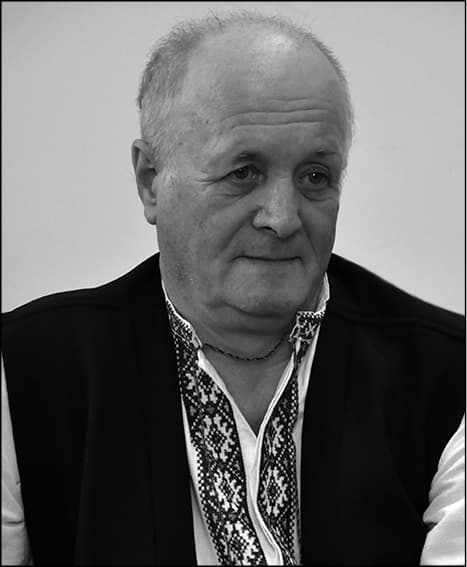
Viktor Nakonechnyi
Віктор Наконечний
1947–2015 · Klembivka, Yampil district, Vinnytsia Oblast, Ukraine
Viktor Nakonechnyi was a self-taught Podillian painter, graphic artist and master of vytynanka paper-cutting and pysanka egg-painting from the embroidery village of Klembivka in Vinnytsia Oblast. He fused Ukrainian folk painting traditions with academic oil and tempera technique to build an enormous body of ethnographic village scenes, and won Ukraine's highest artistic honour, the Shevchenko National Prize, in 2009.
Viktor Andriiovych Nakonechnyi was born on 7 March 1947 in Klembivka, a Vinnytsia Oblast village famous for its artistic embroidery and weaving. He taught himself to draw as a child and apprenticed with the local folk artist Ivan Skorulskyi, later completing the Moscow Correspondence University of Fine Arts in 1985 under H. Honcharov. Lacking a formal academy training, he mastered technique by copying the classics and eventually developed his own method of working in oils, and he worked for years as a staff designer-artist at the Klembivka collective farm (1967–1982) and a forestry station (1983–1990). Alongside painting he practised vytynanka paper-cutting, graphic art, wood carving and pysanka decoration, leaving a reported output of some 3,000–4,000 paintings in oil and tempera, about 1,000 graphic works and several hundred vytynanky. His subjects are the calendar rituals and daily labour of the Podillian village — Christmas Eve carolling, Epiphany, Kupala night, harvest festivals, market days and village women at work — treated with what critics called a tendency toward philosophical generalisation. He exhibited regionally and nationally from 1985, with solo shows in Kyiv (2000, 2007, 2009, 2014) and Vinnytsia (2000, 2009, and posthumously 2017). He was named Honoured Master of Folk Art of Ukraine, received the Kateryna Bilokur Prize in 2000 for his 1990s cycle on the Podillian village, and in 2009 was awarded the Taras Shevchenko National Prize of Ukraine for the painting series "Краю мій сонячний" ("My Sunny Land"). In 1995 he opened a folk-art museum in his own home in Klembivka; his work is held by the Vinnytsia Regional Art Museum, the Vinnytsia Local History Museum and the Ivan Honchar Museum in Kyiv. He died in Klembivka on 25 December 2015.
Art Movements
Realism
Realism is an artistic movement that sought to depict reality as accurately and objectively as possible, holding that the purpose of art is to reflect all aspects of existence, rather than merely its idealized representation. The term was introduced by the French literary critic Jules Champfleury in the 1850s to denote art that opposed Romanticism and Academicism. In the visual arts, the significance of Realism as a style is quite controversial, and its boundaries are undefined. In a narrower sense, realism is understood as positivism, a movement in the visual arts of the second half of the 19th century. One of the first realists was the French artist Gustave Courbet (1819–1877), who opened his solo exhibition “The Pavilion of Realism” in Paris in 1855. Before him, artists of the Barbizon School—Théodore Rousseau, Jean-François Millet, and Jules Breton—worked in a realistic style. In the 1870s, realism split into two main movements: naturalism and impressionism. In contemporary painting, realism borders on the grotesque and anti-glamour.
Explore movement →Folk Decorative Art
Folk decorative art is the visual language of a community, traditionally created by untrained artisans rather than academic artists. It combines utility with ornament, transforming everyday objects like furniture, textiles, and tools into works of cultural expression.
Explore movement →1991–presentContemporary Ukrainian Painting
Painting made in independent Ukraine, from the 1991 declaration of independence onward. It is pluralist rather than programmatic: plein-air landscape and psychological portraiture continue alongside conceptual, minimalist and symbolist strands, with a marked turn after 2014 and especially after 2022 toward wartime subjects, national memory and the vernacular Ukrainian village.
Explore movement →Works by Viktor Nakonechnyi
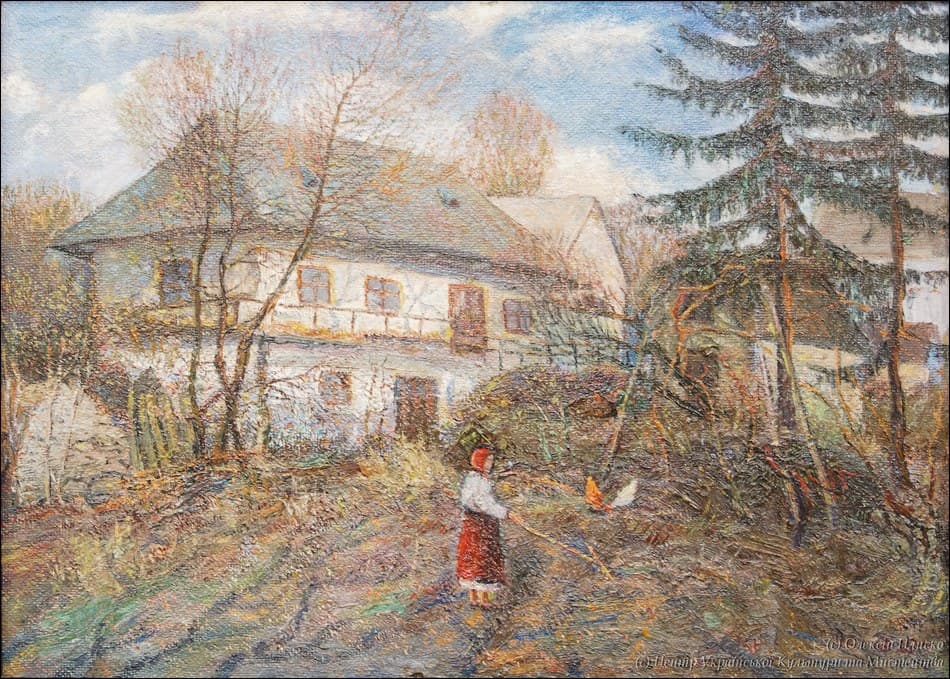
Generous Evening
A Ukrainian Christmas-Eve ritual scene, one of the works singled out by the Encyclopedia of Modern Ukraine as representative of Nakonechnyi's calendar-rite cycle. It shows the shchedrivka carolling tradition of the Podillian village rendered in his folk-inflected oil technique.
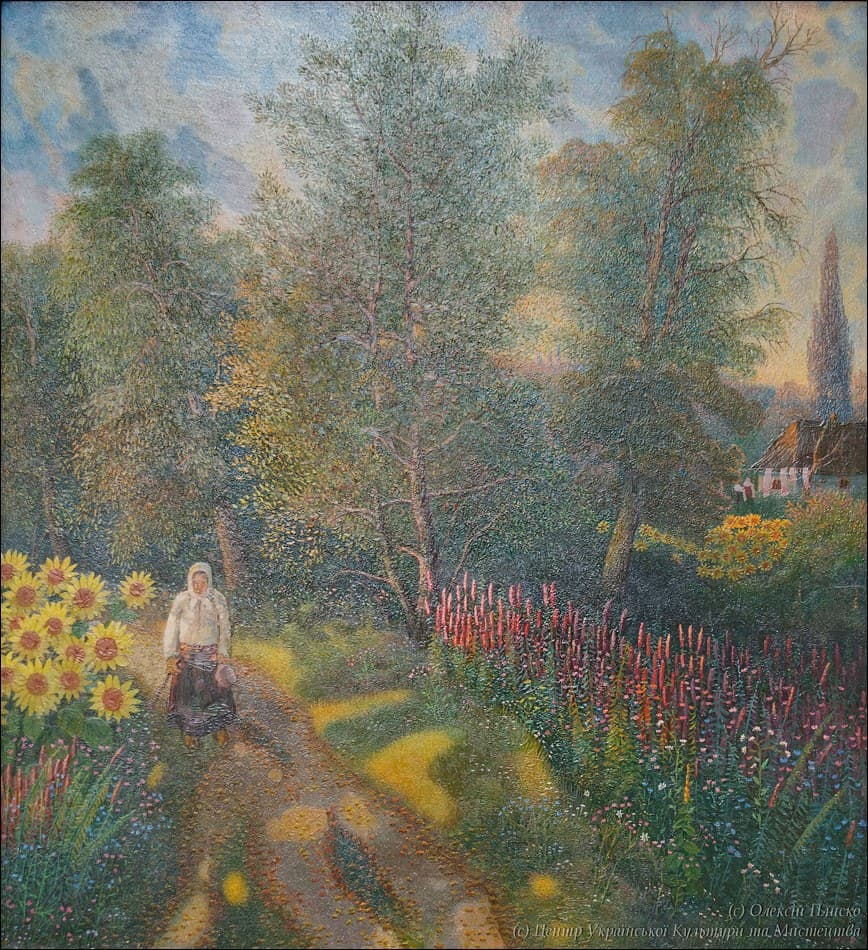
Sunflowers in Bloom
A late still-life/landscape of blossoming sunflowers, listed by the Encyclopedia of Modern Ukraine among the artist's key oil and tempera paintings. Sunflowers recur across his work as an emblem of the Podillian countryside.