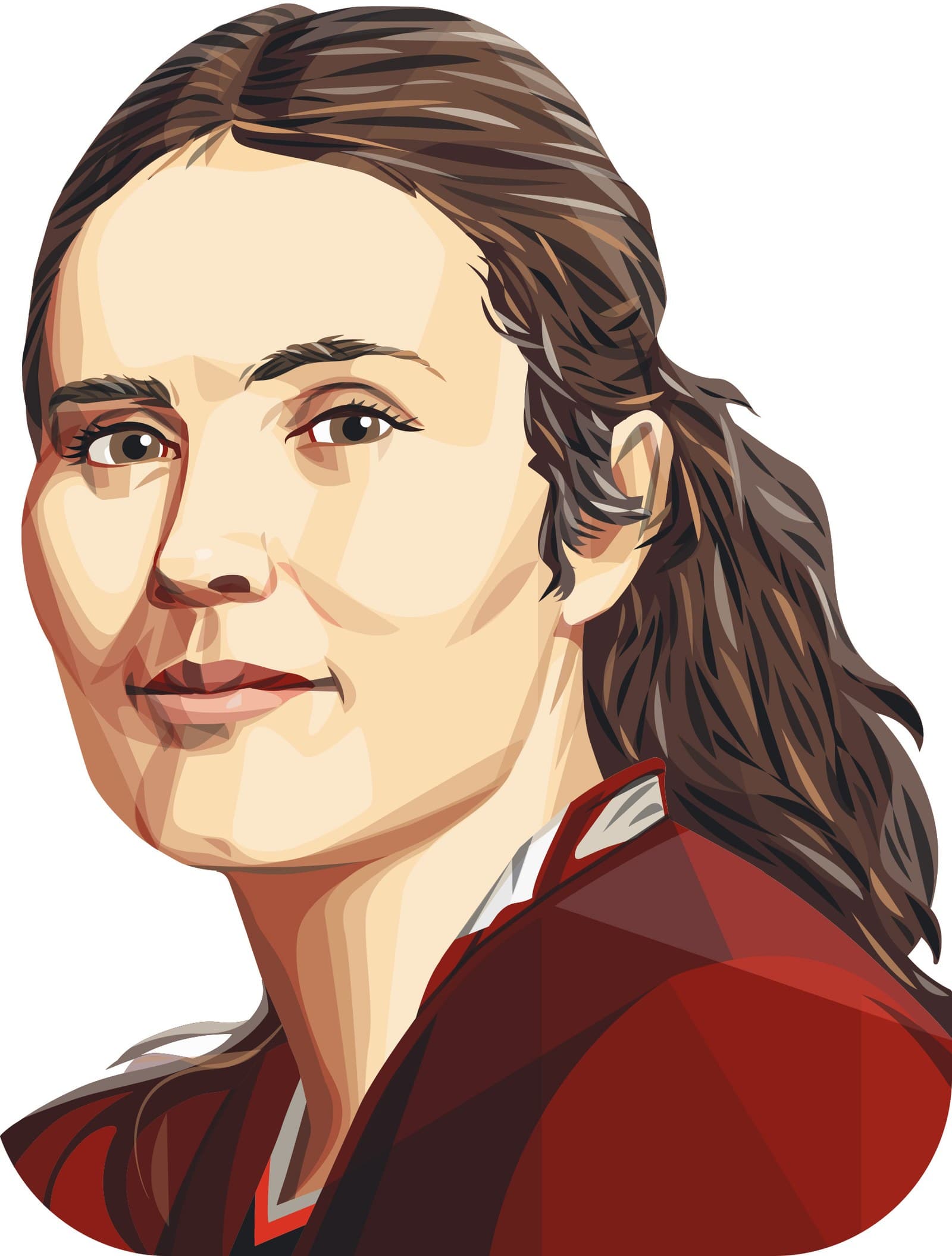
Tetiana Yablonska
Тетяна Яблонська
1917–2005 · Smolensk, Russian Empire
Tetiana Yablonska was one of the defining painters of twentieth-century Ukraine, whose sixty-year career ran from prize-winning Socialist Realist canvases to intensely personal late pastels. Trained in Kyiv under Fedir Krychevskyi, she won three USSR State Prizes yet repeatedly collided with the Party over its control of art. Her 1969 canvas 'Youth' and her folk-inflected paintings of the 1960s mark her as one of the artists who reopened Ukrainian painting to something other than official doctrine.
Tetiana Yablonska was born in Smolensk in 1917 into a family of teachers who drew together at home; the family moved to Odesa in 1928 and later to Kamianets-Podilskyi and Luhansk before she left for Kyiv. She studied painting at the Kyiv State Art Institute from 1935 to 1941 in the studio of Fedir Krychevskyi, and after wartime evacuation to the Saratov region she returned to teach drawing, painting and composition there from 1944. Her breakthrough came from a 1948 student field trip to the village of Letava, from whose sketches she built the four-metre-wide 'Bread' (1949), which won a Stalin Prize and international medals and entered the Tretyakov Gallery as an exemplar of Socialist Realism. She won further state prizes for 'Spring' (1951) and 'Flax' (1979), served as a deputy of the Ukrainian SSR Supreme Soviet, and became a full member of the USSR Academy of Arts in 1975. Official standing did not make her compliant: at the 1968 congress of Ukrainian artists she attacked Party 'tutelage' of art, after which her painting 'Life Goes On' was pulled from exhibition and she was stripped of her posts until the official who threatened her was himself removed, and an entire print run of an album pairing her folk-style work with poems by Ivan Drach was destroyed 'for nationalism'. From the early 1960s she turned deliberately to Ukrainian folk art, travelling to villages and meeting Mariia Prymachenko, and works such as 'At the Fair in Solotvyn' (1960), 'The Wedding' (1963) and 'Summer' (1967) reshaped her sense of rhythm and colour. Her 1969 'Youth', painted from life at Sedniv, is now read by Ukrainian art historians as a turning point away from doctrinal painting altogether. After a heart attack in 1999 cost her the use of her right hand she taught herself to paint left-handed, abandoned oils for pastel, and worked until her death in Kyiv in 2005.
Art Movements
Impressionism
Impressionism was a 19th-century French art movement (1870s-1880s) that revolutionized Western art by capturing fleeting moments and the shifting effects of light using visible brushstrokes, open composition, and vibrant colors. Focusing on modern life and landscapes, key artists included Claude Monet, Pierre-Auguste Renoir, Camille Pissarro, and Berthe Morisot. Usage Examples & Characteristics: Plein Air Painting: Painting outdoors to capture natural light, such as Monet’s studies of Rouen Cathedral or haystacks in varying weather conditions. Visible Brushwork: Thick, rapid, or broken brushstrokes intended to convey a sense of motion and the ephemeral nature of a scene. Everyday Subjects: Depicting leisure activities, urban life in Paris, or landscapes rather than historical or mythological scenes. Unusual Visual Angles: Inspired by photography, artists like Degas used candid-style, unconventional framing of subjects, such as dancers or laundresses. "Impressionist Music": A similar approach in music and dance, focusing on mood and atmosphere over rigid structure, with artists like Claude Debussy and Maurice Ravel.
Explore movement →Social Realism
Social Realism is an international art movement—spanning painting, photography, literature, and film—that emerged in the mid-19th century and peaked in the 20th century to expose the harsh socio-political conditions of the working class. It functions as a critical, unidealized depiction of poverty, labor struggles, and structural inequality to challenge power structures. Key Characteristics and Context Purpose: To draw attention to the everyday hardships of the poor and working classes, often functioning as a critique of capitalist, industrial, or governmental systems. Origin: The movement grew from 19th-century French and Russian realism, reacting against romanticism and bourgeois art styles. Resurgence: It thrived between the World Wars and during the 1930s Great Depression, particularly in the U.S. and Mexico, focusing on themes of labor, community, and resilience. Style: It emphasizes subject matter over form, often using a descriptive, gritty, and direct visual language.
Explore movement →mid-1950s – 1970sSixtiers (Shistdesiatnyky)
A generation of Ukrainian artists, writers and intellectuals who emerged during the post-Stalin Thaw and pushed back against imposed Socialist Realism by reconnecting with Ukrainian folk form, Byzantine and Cossack-era sources, and European modernism. Centred in Kyiv on the Club of Creative Youth 'Suchasnyk' (founded 1959–62), the circle included Alla Horska, Opanas Zalyvakha, Halyna Sevruk, Liudmyla Semykina and Veniamin Kushnir. Most were expelled from official structures, blacklisted or imprisoned after the 1965 and 1972 waves of arrests, and much of their work was destroyed or hidden until the late 1980s.
Explore movement →Works by Tetiana Yablonska
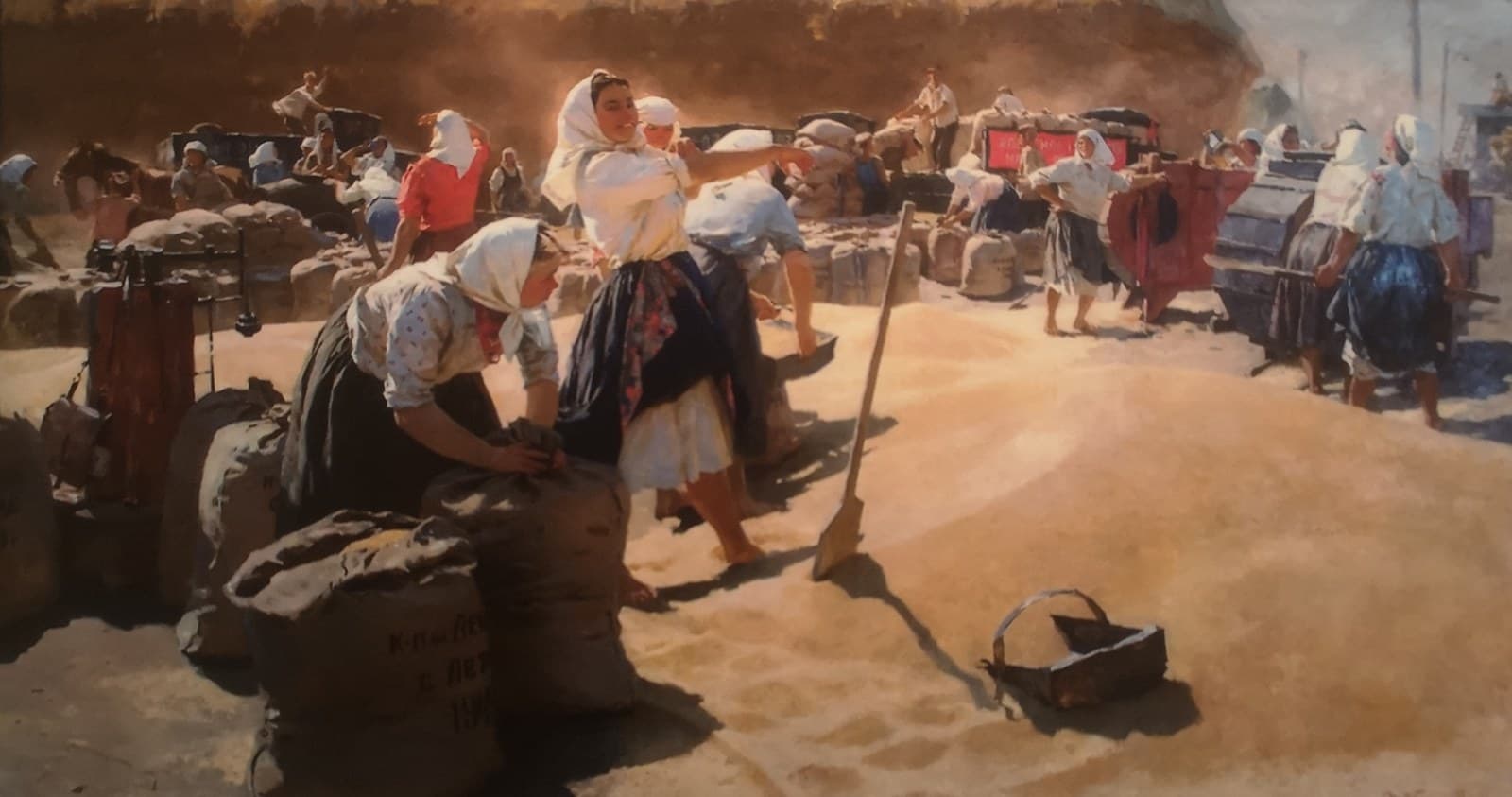
Bread
Yablonska's four-metre-wide threshing-floor scene, built from sketches made in the village of Letava in 1948 where 717 of 765 able-bodied villagers were women. It won a Stalin Prize in 1949 and a bronze medal at the 1958 Brussels World's Fair, and hangs in the Tretyakov Gallery as a canonical work of Socialist Realism.
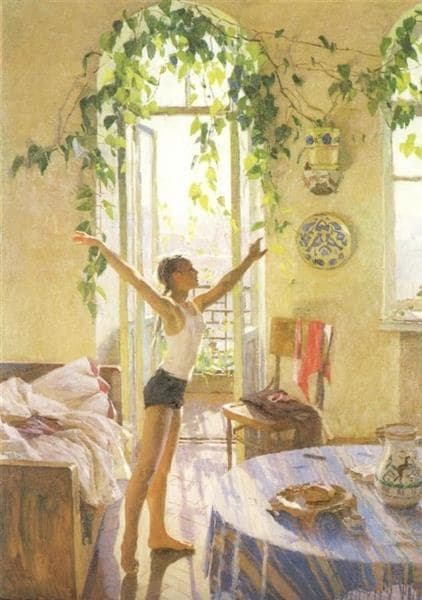
Morning
A thirteen-year-old girl — the artist's elder daughter Olena — doing morning exercises in the family's Kyiv flat, painted in the first light of the Khrushchev Thaw. Reproduced in 'Ogoniok', on postcards and in school readers, it became one of the most widely seen Soviet-era paintings, though Yablonska herself was never satisfied with it.
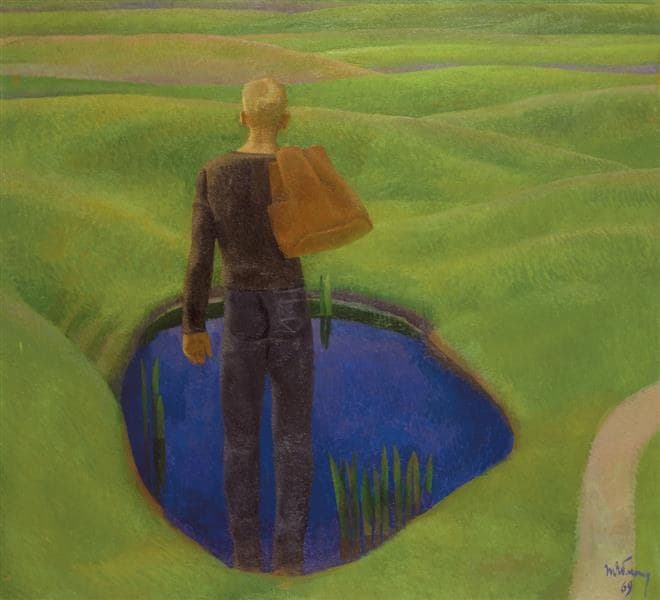
Youth
A boy with a rucksack stands at the edge of a small blue pond on a green pasture; Yablonska began the picture as a study of the pond at Sedniv and asked the boy, who wandered over from a nearby sports camp, to pose. Ukrainian critics read it as a manifesto of solitary self-possession and a step away from doctrinal Socialist Realism.
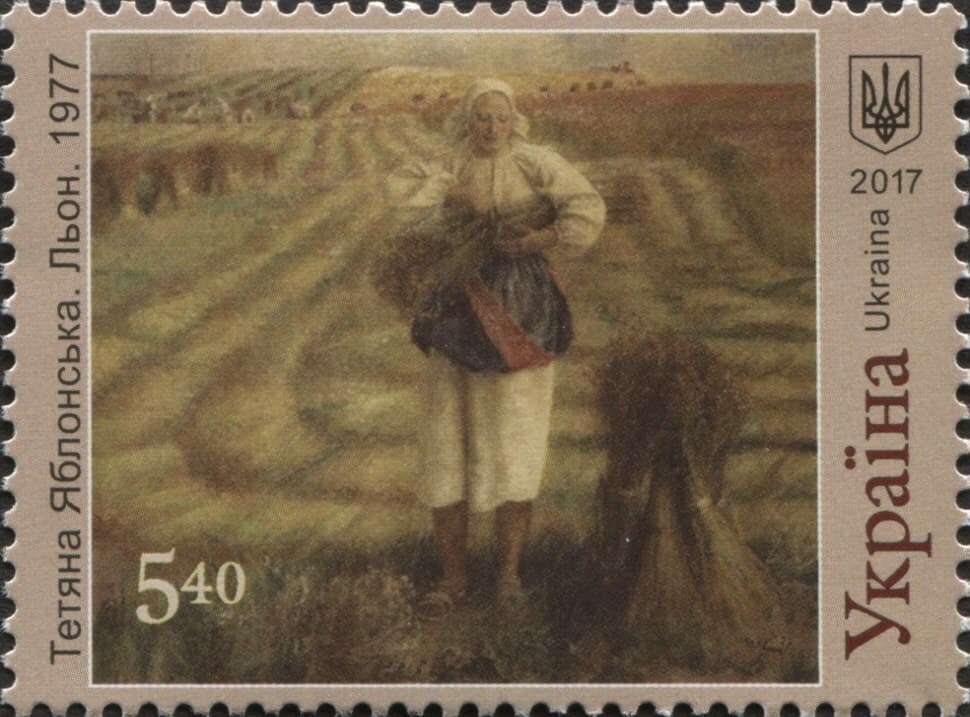
Flax
A woman gathering flax in a striped, receding field, painted in the muted earth register of Yablonska's late-1970s village pictures. It won her the USSR State Prize in 1979 and was chosen by Ukrposhta in 2017 for its 'Famous Women of Ukraine' stamp marking her centenary.