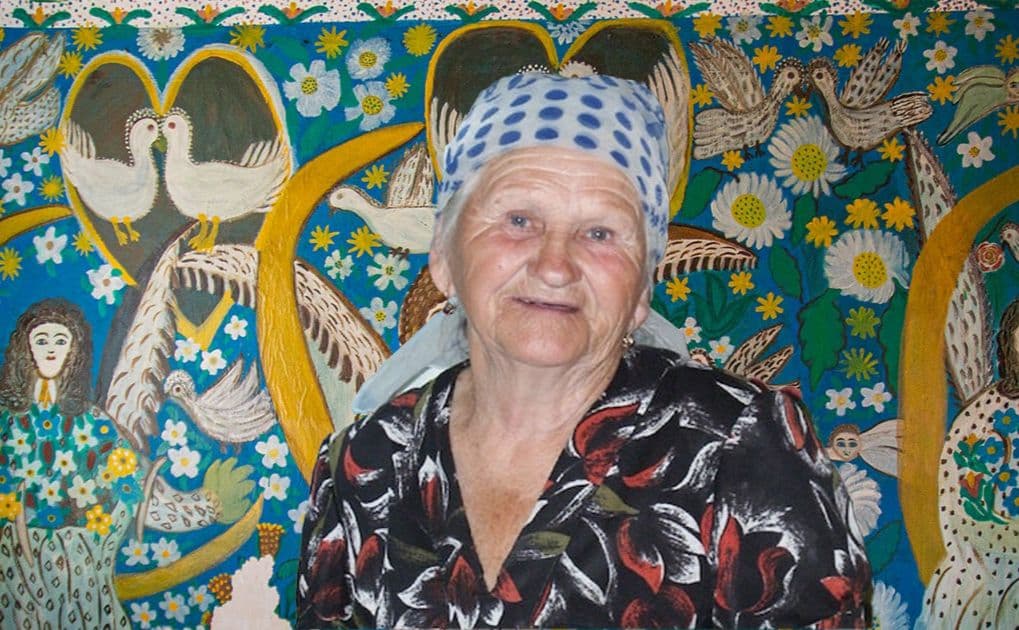
Polina Raiko
Поліна (Пелагея) Андріївна Райко
1928–2004 · Tsiurupynsk (now Oleshky), Kherson region, Ukrainian SSR
Polina Raiko was a Ukrainian self-taught naive artist from Oleshky in the Kherson region who began to paint at the age of sixty-nine. Over roughly six years she covered the walls and ceilings of her own six-room house, its summer kitchen, gates and fences with enamel-paint murals of angels, birds, animals and family memories. The house became a cult site of Ukrainian outsider art and was destroyed in June 2023 by the flooding that followed the Russian destruction of the Kakhovka dam.
Pelaheia (Polina) Andriivna Raiko was born in 1928 in Tsiurupynsk, now Oleshky, a small town across the Dnipro from Kherson. Her life was marked by successive catastrophes: she survived the Holodomor and was deported to Germany as forced labour during the Second World War, married the fisherman Mykola Raiko in 1950 and endured his drinking and violence, lost her daughter Olena in a car accident in 1994 and her husband in 1995, and lost her son Serhii, who had been imprisoned and struggled with alcoholism, to cirrhosis in 2002. She had no artistic training whatsoever. In the autumn of 1998, at the age of sixty-nine, she painted a white dove on her gate at a neighbour's suggestion, and from that beginning worked for about six years — mostly at night — until the whole of her property at 74 Nyzhnia Street was covered: the six rooms of the house, their ceilings, the stove, the summer kitchen, the garage doors, the gates and fences, and eventually her relatives' graves in the cemetery. She used the cheapest material available, PF enamel house paint, spending nearly all of her 74-hryvnia monthly pension on paint and brushes. The murals mix Christian imagery — churches, angels, saints, the Virgin, Christ — with family portraiture translated into symbol: her two sisters as angels seated on crescent moons, her husband as a bearded boatman surrounded by coloured bottles, her dead children guarded by an angel, a figure in green military dress that recalls her wartime deportation, and throughout them white storks, roosters, gold-and-black owls, deer, fish and flowers. After her death on 15 January 2004 her grandson sold the house for five thousand dollars to Andrius Nemickas, a Canadian, and a charitable foundation in her name was set up to conserve and promote the work; in 2013 the Ivan Honchar Museum's National Centre of Folk Culture documented and filmed the interiors, and the house was listed as a monument of local significance in 2021. On 6 June 2023 the Russian destruction of the Kakhovka dam flooded Oleshky and the house-museum was submerged, destroying the murals; the surviving photographic and video documentation is now the whole of her legacy, and her imagery has since been adopted in Kherson as a symbol of cultural resistance.
Art Movements
Folk Decorative Art
Folk decorative art is the visual language of a community, traditionally created by untrained artisans rather than academic artists. It combines utility with ornament, transforming everyday objects like furniture, textiles, and tools into works of cultural expression.
Explore movement →20th century – presentNaive Art
A current of self-taught, non-academic painting in which artists without formal training build highly personal pictorial worlds out of folk memory, religious imagery, dreams and invented flora and fauna. In Ukraine it is the tradition of Kateryna Bilokur, Maria Prymachenko and Polina Raiko: flat, ornamentally organised, intensely coloured compositions that reject perspective and academic modelling in favour of rhythm, pattern and symbolic narrative. Ukrainian naive art is closely intertwined with village decorative painting, and after 2022 became a widely used emblem of national cultural resilience.
Explore movement →Works by Polina Raiko
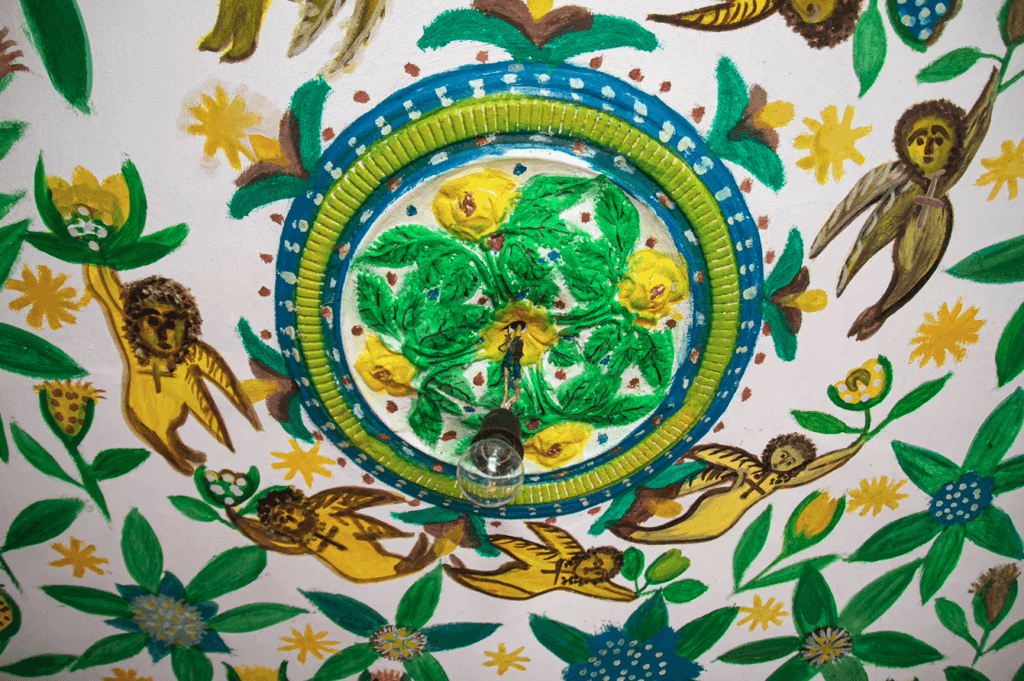
Angels on the Ceiling
Flying angels scattered across a ceiling filled with a sea of green and blue flowers, edged with a blue-and-yellow border. Painted between 1998 and 2004 as part of Raiko's total decoration of her own house.
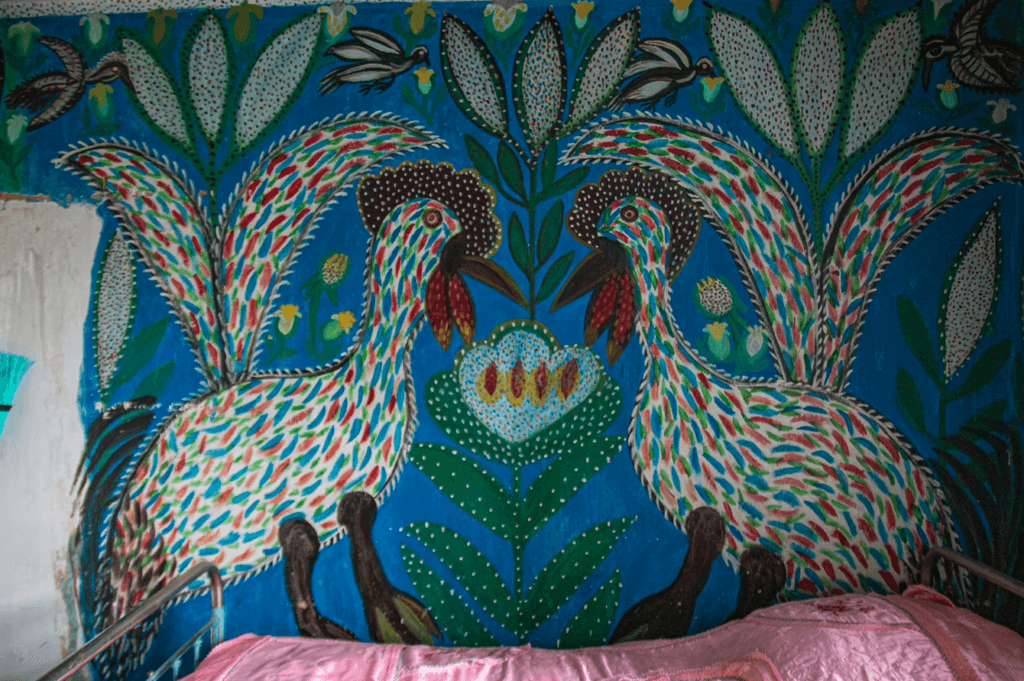
White Roosters
Two large white roosters with green and red highlights facing each other across a bedroom wall, among the most reproduced images from the house. Roosters, storks and owls were Raiko's recurring guardians of the domestic interior.
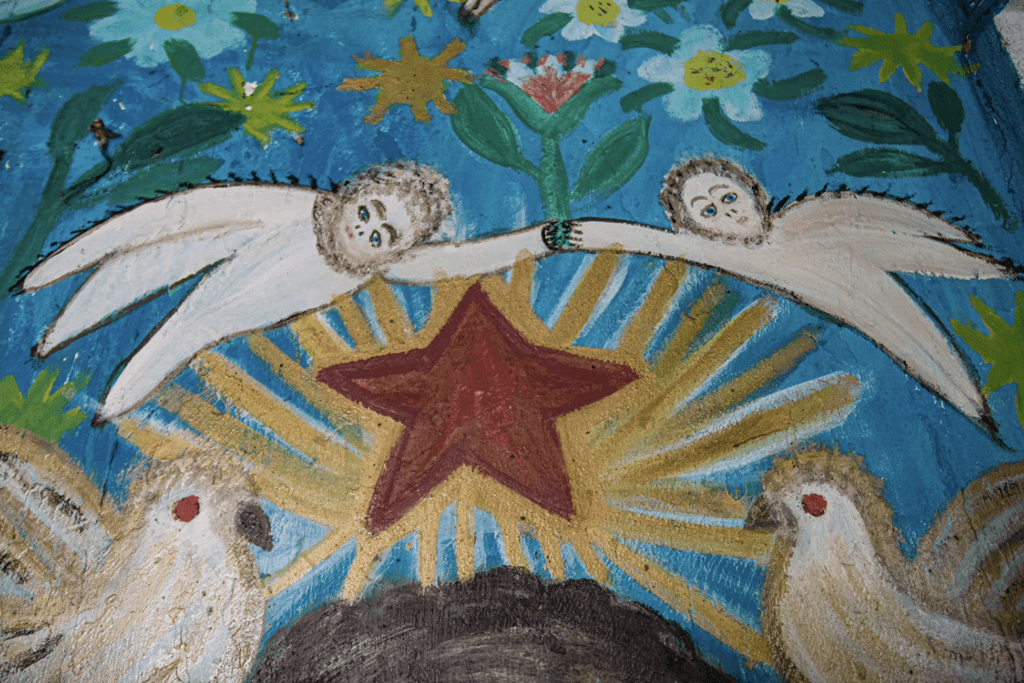
The Fisherman
Raiko's husband Mykola shown as a bearded fisherman-boatman playing a stringed instrument amid rows of coloured bottles, an unsparing but affectionate account of his drinking. It is the clearest example of her turning family biography directly into mural narrative.
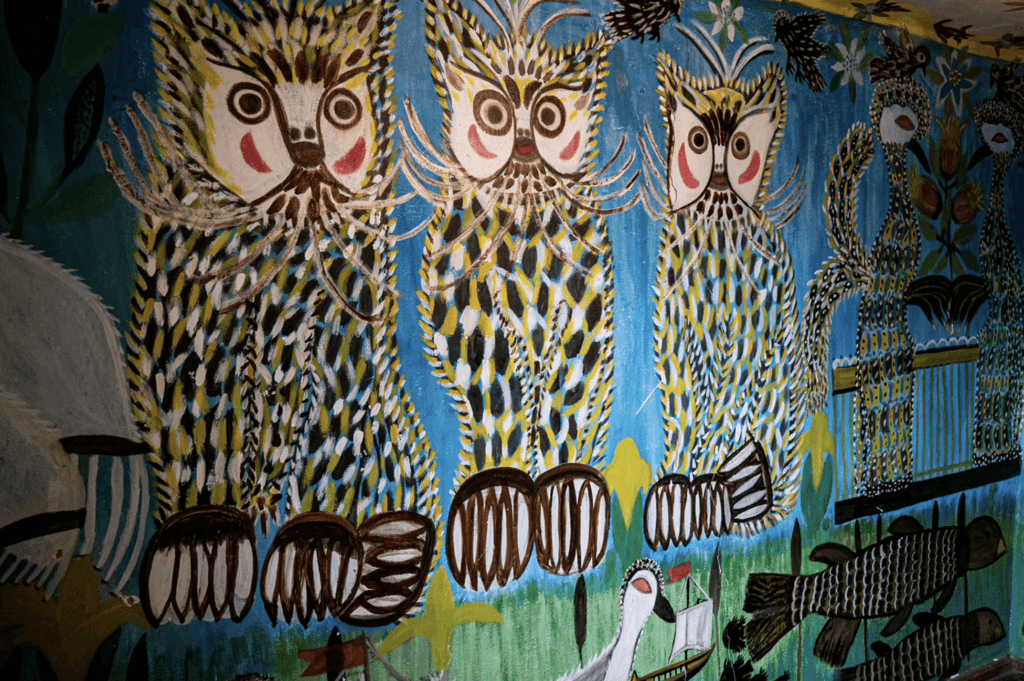
Owls
Black-and-gold owls with individually characterised faces, read by commentators as a tribute to Raiko's sisters, one of them shown with a blackbird in its beak. The owl is the closest thing in the house to a self-portrait motif.
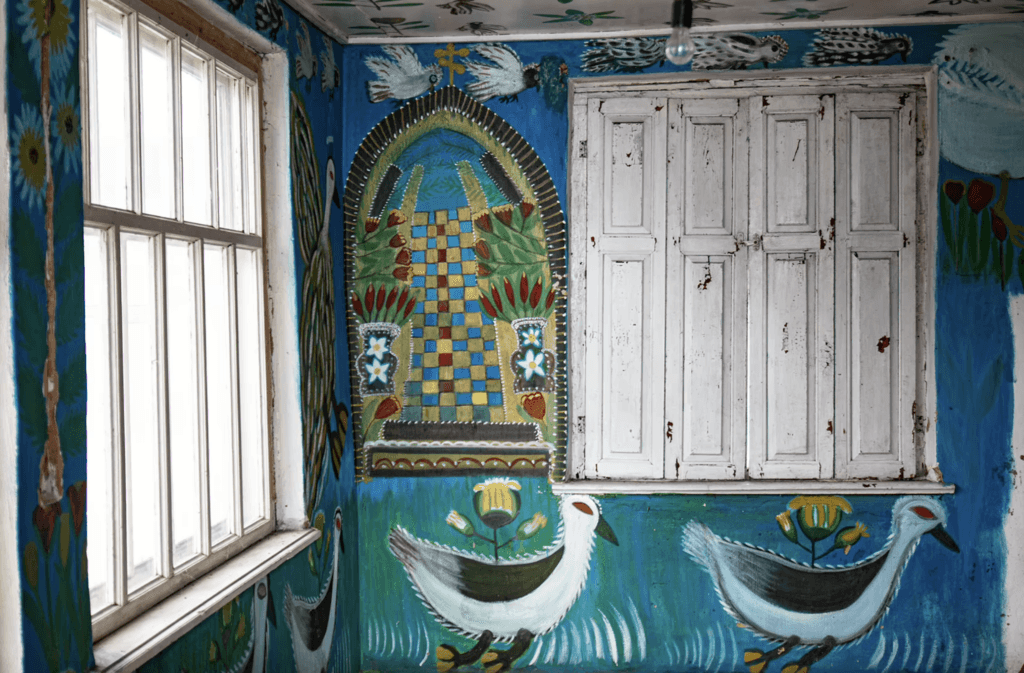
Storks
White storks with yellow feet and red eyes carrying yellow flowers on their backs, painted in the national bird's traditional role as bringer of good fortune to a house. Part of the continuous band of birds that ran through every room.