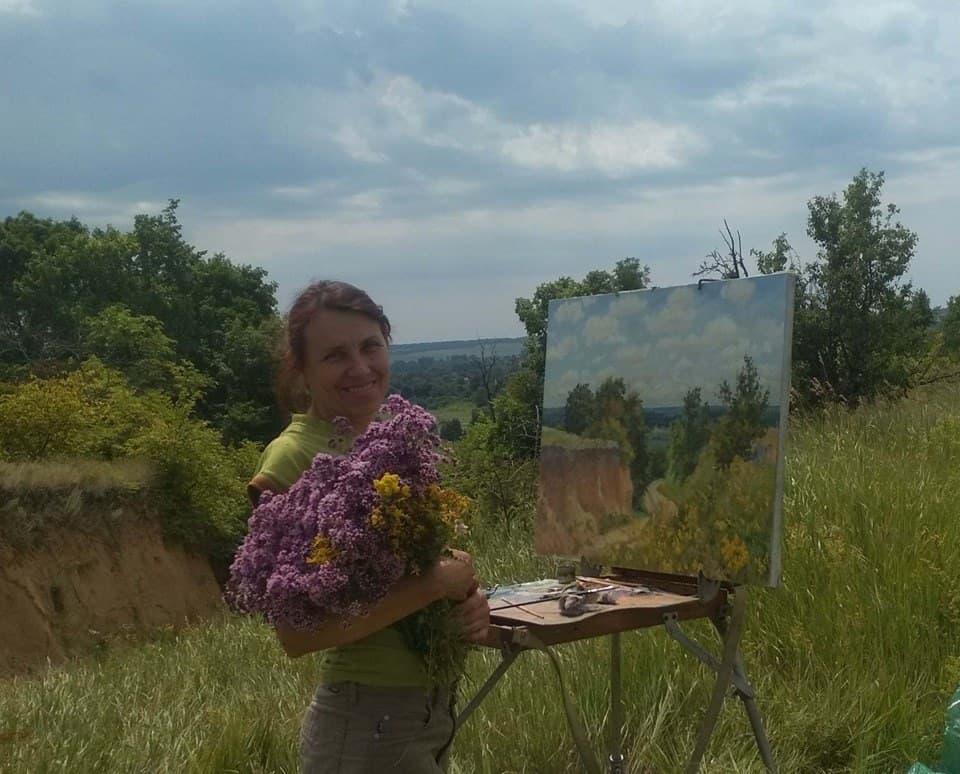
Nadiia Poluian-Vnukova
Надія Полуян-Внукова
b. 1968 · Romny, Sumy Oblast, Ukraine
Nadiia Poluian-Vnukova is a Ukrainian painter born in Romny, Sumy Oblast, in 1968 and still living and working there, a member of the National Union of Artists of Ukraine since 2004. Trained first as a decorative painter and textile designer, she paints minutely detailed, sunlit interiors, still lifes of wild flowers in ceramic jugs, and scenes of Christmas and childhood in her native Romny district.
Nadiia Volodymyrivna Poluian-Vnukova was born on 3 January 1968 in Romny, Sumy Oblast, where she still lives. She finished Romny secondary school no. 7 in 1983, studied painting privately with Lina Breus and apprenticed with the artist Valerii Zosenko, then trained from 1983 to 1987 at Romny Vocational School no. 14 as a decorative building painter and later took courses at the Lviv Institute of Applied and Decorative Arts. After vocational school she worked at the Romny curtain-and-tulle factory designing new textile patterns for production, completed designer refresher courses at the Kyiv Institute of Technology for Light Industry in 1989, and then left industry to paint full time. She was admitted to the National Union of Artists of Ukraine in 2004. She works across landscape, still life, thematic composition and portrait, and is known for meticulous botanical detail — forest and field flowers gathered in ceramic vessels — and for warm, memory-laden interiors and yards drawn from the Romny localities of Voshchylykha and Obolonnia, subjects she describes as filled with sunlight and childhood. Her first solo exhibition was in Kyiv in 1994, followed by Sumy (1997), Romny and Kyiv (2002), Kyiv (2003) and Konotop (2009), and she takes part regularly in all-Ukrainian exhibitions. Her paintings are held by the National Taras Shevchenko Museum in Kyiv, Ukrainian House, the Sumy Art Museum, the Lebedyn Art Museum and the Romny Regional Museum, as well as private collections abroad.
Art Movements
Realism
Realism is an artistic movement that sought to depict reality as accurately and objectively as possible, holding that the purpose of art is to reflect all aspects of existence, rather than merely its idealized representation. The term was introduced by the French literary critic Jules Champfleury in the 1850s to denote art that opposed Romanticism and Academicism. In the visual arts, the significance of Realism as a style is quite controversial, and its boundaries are undefined. In a narrower sense, realism is understood as positivism, a movement in the visual arts of the second half of the 19th century. One of the first realists was the French artist Gustave Courbet (1819–1877), who opened his solo exhibition “The Pavilion of Realism” in Paris in 1855. Before him, artists of the Barbizon School—Théodore Rousseau, Jean-François Millet, and Jules Breton—worked in a realistic style. In the 1870s, realism split into two main movements: naturalism and impressionism. In contemporary painting, realism borders on the grotesque and anti-glamour.
Explore movement →Folk Decorative Art
Folk decorative art is the visual language of a community, traditionally created by untrained artisans rather than academic artists. It combines utility with ornament, transforming everyday objects like furniture, textiles, and tools into works of cultural expression.
Explore movement →1991–presentContemporary Ukrainian Painting
Painting made in independent Ukraine, from the 1991 declaration of independence onward. It is pluralist rather than programmatic: plein-air landscape and psychological portraiture continue alongside conceptual, minimalist and symbolist strands, with a marked turn after 2014 and especially after 2022 toward wartime subjects, national memory and the vernacular Ukrainian village.
Explore movement →Works by Nadiia Poluian-Vnukova
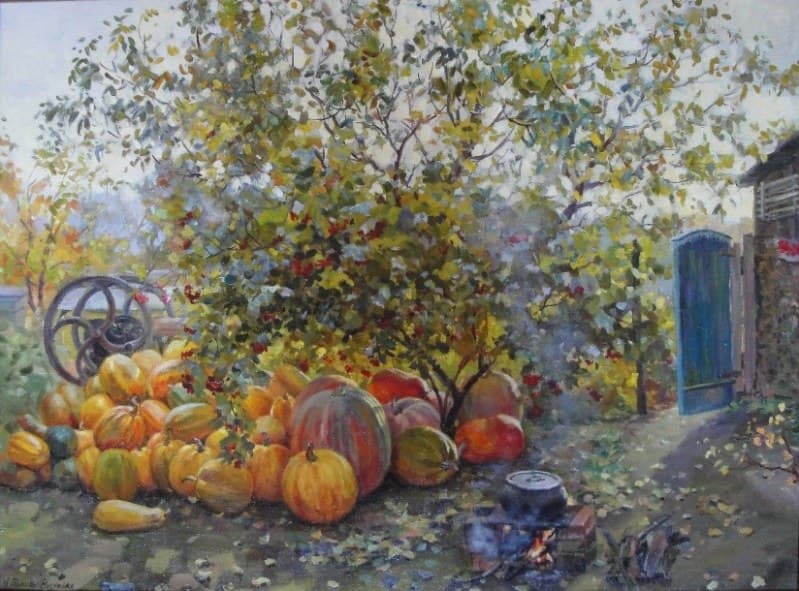
Nostalgia
A memory-driven composition typical of the artist's central theme, the sunlit village world of her childhood. Reproduced under this Ukrainian title in the Romny literary-historical almanac.
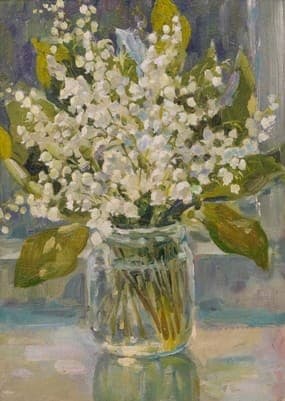
Lilies of the Valley
A close still life of lilies of the valley, showing the minute botanical detail the artist is known for. Wild forest and field flowers in simple vessels are one of her signature genres.
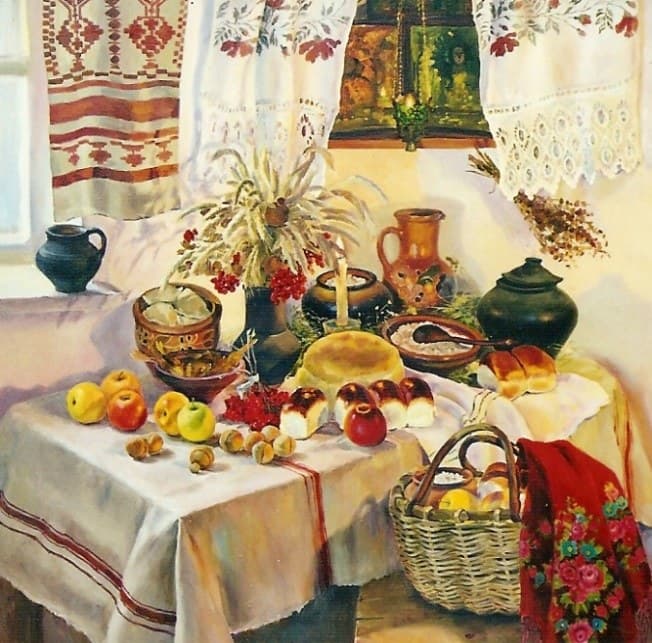
Holy Evening
A Ukrainian Christmas Eve interior, one of the artist's recurring holiday subjects rooted in her Romny childhood. Reproduced under this Ukrainian title in the Romny literary-historical almanac.
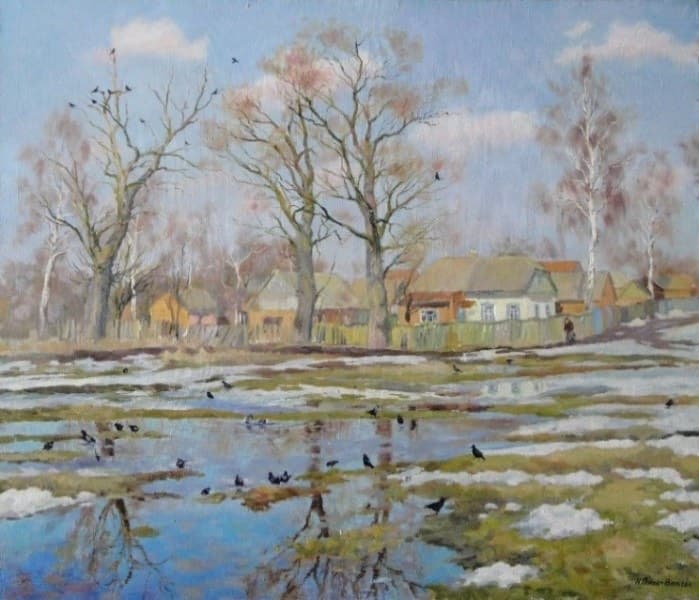
A Day in March. Obolonnia
An early-spring view of Obolonnia, one of the two Romny localities the artist returns to again and again. The place name in the title anchors her work firmly to the Sumy region.
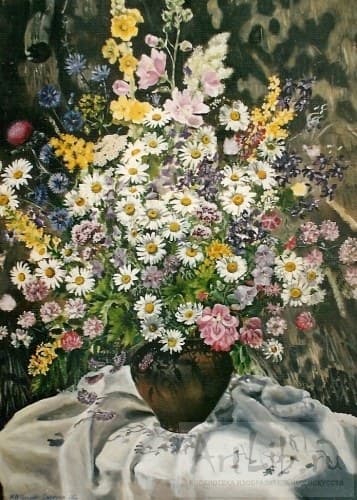
Flowers from Childhood
One of the artist's best-known titles, named in her Ukrainian Wikipedia entry among her signature works. It joins her two central preoccupations — wild flowers and remembered childhood.