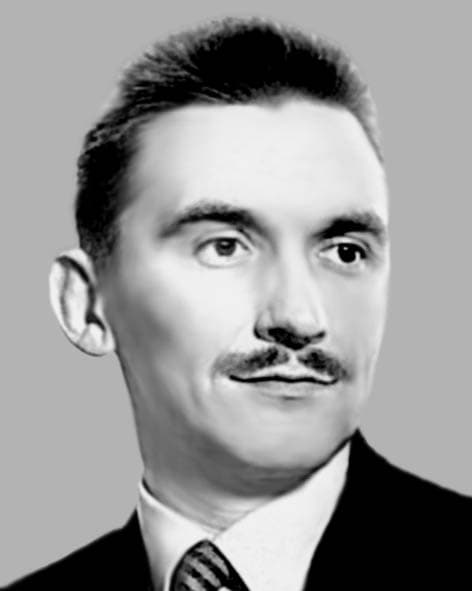
Liuboslav Hutsaliuk
Любослав Михайлович Гуцалюк
1923–2003 · Lviv, Ukraine (then Poland)
Liuboslav Hutsaliuk was a Lviv-born painter who emigrated to New York in 1949 and became one of the leading figures of Ukrainian diaspora modernism. Working between studios in New York and Paris, he built a distinctive body of cityscapes in which cathedral spires, rooftops and bridges dissolve into thick vertical impasto and two- or three-note colour harmonies.
Liuboslav Mykhailovych Hutsaliuk was born on 2 April 1923 in Lviv. He was wounded during the Second World War as a soldier of the Galicia Division, and afterwards, in the displaced-persons years of 1946–49, studied at Edward Kozak's art studio in Berchtesgaden, Germany. He emigrated to the United States in 1949, married Renata Kozicky in 1951, took US citizenship, and graduated from the Cooper Union School of Art in New York in 1954, holding his first solo exhibition the same year. From 1955 he divided his working life between studios in New York and Paris. His first Paris show at Galerie Ror Volmar in December 1956 was followed by a 1959 exhibition at which a Bergamo dealer bought 23 of the 25 paintings before the opening; further one-man shows followed in Paris, New York, Milan and Toronto. His subject was almost always the city without people: Gothic cathedrals, Parisian courtyards and bridges, New York skyscrapers and wooden churches in Ukrainian settlements in America, all built from a dense vertical impasto that critics variously called expressionist and neo-impressionist, and restricted to two or three dominant colours. Critics Yurii Solovii and Vasyl Barka wrote of his 'psychologism' and his 'gothic spirituality' — an aspiration to verticality and light expressed in purely contemporary means. He was a member of the New York Group, Audubon Artists, La Société des Artistes Indépendants de Paris and the Association of Ukrainian Artists in America, an honorary member of the Campanella Academy in Rome (silver medal for painting, 1970), and also worked as a cartoonist and graphic designer, contributing to the Ukrainian satirical journal Lys Mykyta and writing art criticism for Svoboda and Suchasnist. He suffered a stroke in 1990 but recovered and kept painting; his retrospective 'Five Decades' was held at the Ukrainian Institute of America in 1999. He stopped working after the deaths of his wife Renata and son Yarema, died in New York on 16 December 2003, and is buried at St Andrew's Ukrainian Cemetery in South Bound Brook, New Jersey. His work is in collections in France, Britain, Italy and Canada, and in the Palm Springs Art Museum and the Vermont Arts Center.
Art Movements
Post-Impressionism
Post-Impressionism (c. 1886–1905) was a French art movement that reacted against the limitations of Impressionism, favoring emotional expression, symbolic content, and structural order over realistic light depiction. Key artists included Cézanne, Van Gogh, Gauguin, and Seurat, who used vivid, unnatural colors and thick paint application to create unique styles that paved the way for modern art. Key Characteristics Symbolic and Emotional Content: Pushing beyond the objective recording of nature to express subjective emotions and symbolic meaning. Structural Order: A move away from fleeting moments toward, as Paul Cézanne aimed, making of Impressionism "something solid and durable, like the art of the museums". Vivid, Non-Naturalistic Color: Using color for emotional or decorative impact rather than just representing natural light. Distinctive Techniques: Examples include Seurat's Pointillism (tiny, systematic dots of color) and Van Gogh's expressive, swirling brushwork.
Explore movement →Modernism
Modernism was a radical, early-to-mid-20th-century cultural movement that broke with traditional artistic, literary, and social forms to align with a rapidly industrializing world. Characterized by experimentation, abstraction, and individualism, it sought new modes of expression to address themes of alienation and social change following World War I. Rejection of Tradition: Modernists rejected Victorian morality, academic art, and realistic depictions of subjects, seeking to "make it new". Experimentation: A shift towards abstraction in art (e.g., Cubism) and new techniques in literature, such as stream of consciousness (e.g., Virginia Woolf, James Joyce). Key Themes: Focused on subjectivity, alienation, the fragmentation of reality, and the quest for new meaning. Architecture & Design: Marked by minimalism, functionalism, and the use of industrial materials, famously summarized by Le Corbusier’s "a building is a machine for living in". Time Period: Roughly 1890s–1960s, emerging in Europe and America as a response to urbanization and technological advances.
Explore movement →1945 – 2000sUkrainian Diaspora Modernism
The modernist current developed by Ukrainian artists who left Ukraine during and after the Second World War and rebuilt their careers in the displaced-persons camps of Germany and then in New York, Paris, Toronto and Chicago. Working outside Soviet censorship, they absorbed abstraction, expressionism and post-war European painting while keeping Ukrainian subject matter, sacred architecture and identity in view. Institutional anchors included the Association of Ukrainian Artists in America (OMUA), the New York Group, the Ukrainian Institute of America and the Ukrainian Museum in New York.
Explore movement →1905 – presentExpressionism
A modernist approach that distorts colour, drawing and surface to convey inner emotional and spiritual states rather than optical appearances. In Ukrainian art it runs from the early-twentieth-century Galician and Lviv painters through to post-war diaspora artists, who combined heavy impasto, near-abstract structural drawing and saturated non-naturalistic colour.
Explore movement →Works by Liuboslav Hutsaliuk
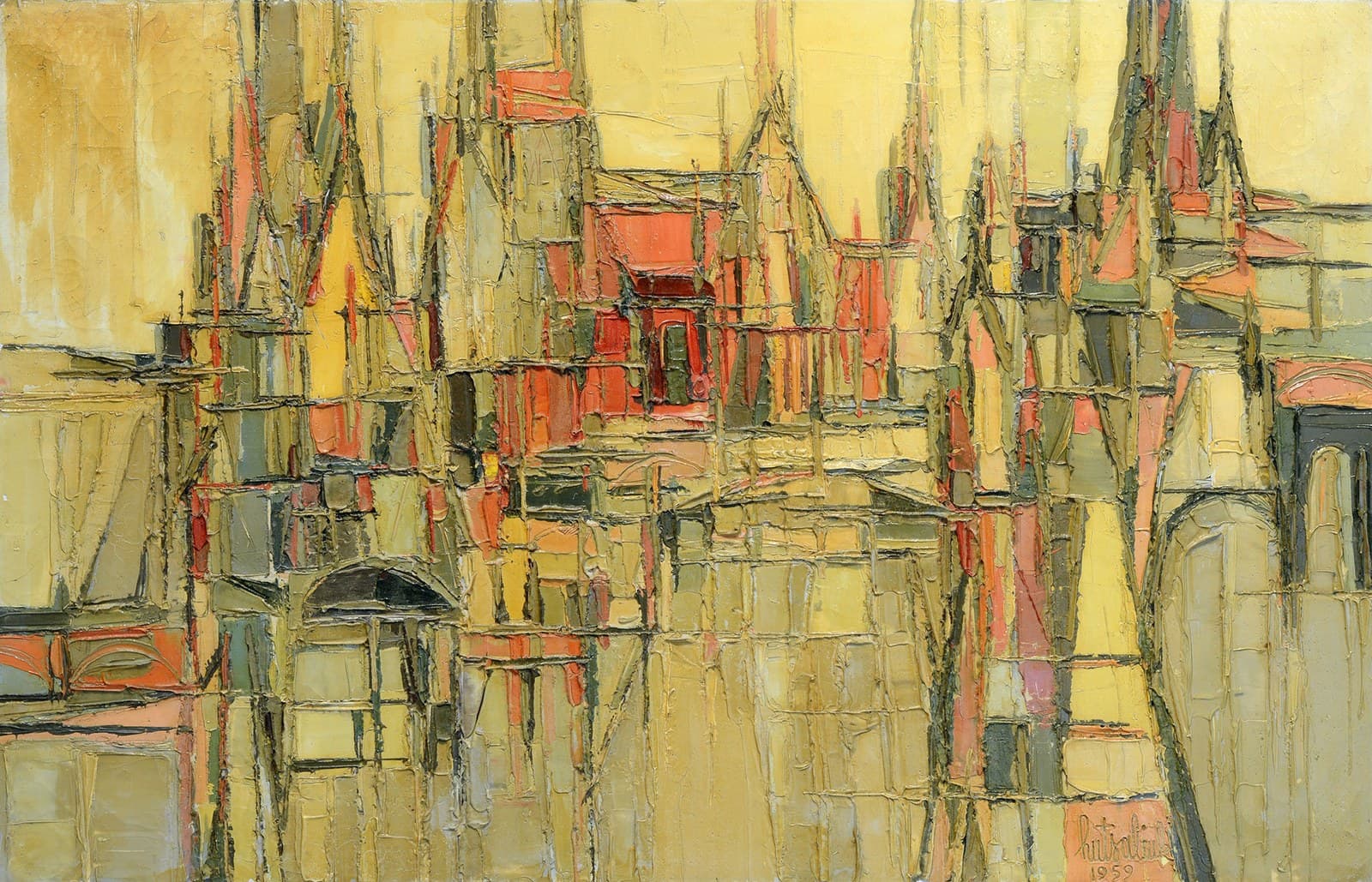
Old Town
A dense old-European townscape of gabled roofs, arcades and pointed spires reduced to a lattice of olive, ochre and coral impasto against a flat yellow sky. Signed and dated lower right 'Hutsaliuk 1959', it is a fully characteristic example of the 'gothicised' city pictures that made his reputation in Paris.
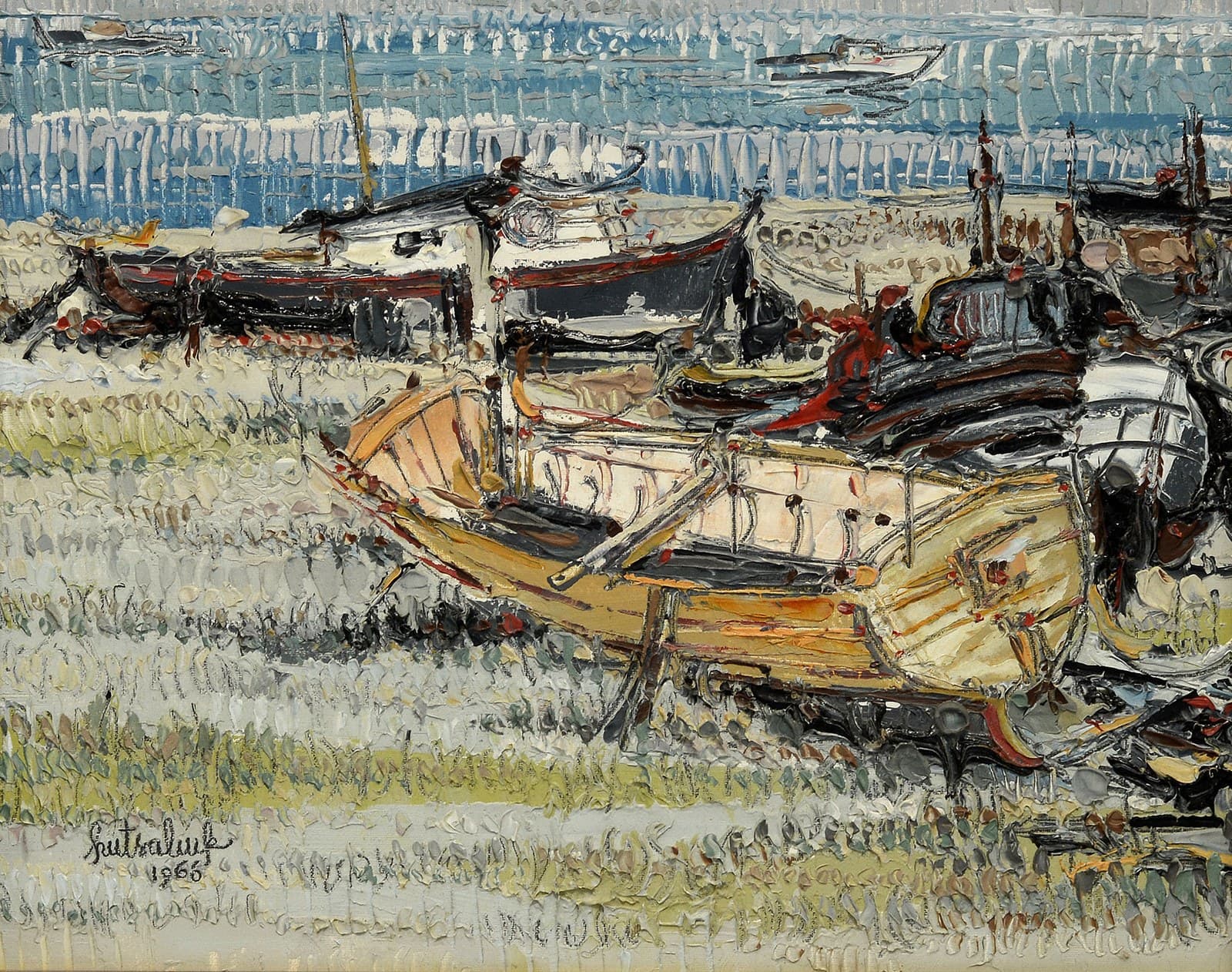
Boats
A small, heavily worked panel of moored boats, showing how Hutsaliuk carried the same vertical impasto and narrow colour range from his large city canvases into intimate formats.