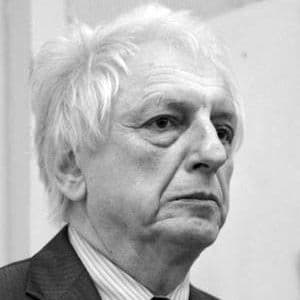
Liubomyr Medvid
Любомир Медвідь
b. 1941 · Varyazh, Sokal district, Lviv oblast, Ukraine
Liubomyr Medvid, born in 1941 in the Lviv-region village of Varyazh, is one of the leading painters of the Lviv school and a professor at the Lviv National Academy of Arts. He is a People's Artist of Ukraine and a full academician of the National Academy of Arts of Ukraine, and won the Shevchenko National Prize in 2014 for his cycle «Ремінісценції». His painting moves between meticulously observed Galician landscape and large philosophical cycles on displacement, exile and Christian ethics.
Liubomyr Myroslavovych Medvid was born on 10 July 1941 in the village of Varyazh in the Sokal district of Lviv oblast, and the wartime deportations and resettlements of his childhood became the permanent subject matter of his art. He graduated from the Lviv Institute of Applied and Decorative Arts in 1965, formally in artistic ceramics, but his decisive teachers were the painters Roman Selskyi, Karlo Zvirynskyi, Vitold Manastyrskyi and Danylo Dovbosynskyi, through whom the modernist current of the Lviv school reached his generation. He began teaching at the institute — now the Lviv National Academy of Arts — in 1966, and became professor in the department of monumental and decorative painting in 2001. Alongside easel painting he has worked extensively in monumental and sacred art, including church commissions in Sukhovolia and Ottawa, the iconostasis of the St Luigi Orione chapel in Lviv, and work for the Cathedral of St George. His major cycles include «Евакуації» (Evacuations), «Емігранти» (Emigrants) and «Галицькі долі» (Galician Fates) of 1982–1987, «Притчі. Блудний син» (Parables. The Prodigal Son) of 1991–1996, «Terra Incognita» of 1993–1995, «Ecce Homo» of 1995–1997 and «Ремінісценції» (Reminiscences) of 2010–2011; he also painted portraits of Lesia Ukrainka, Lev Tolstoi, Mykola Hohol, Mykhailo Hrushevskyi and Ivan Franko. He was named an Honoured Art Worker of Ukraine in 1987 and a People's Artist of Ukraine in 1999, elected a corresponding member of the National Academy of Arts of Ukraine in 2003 and a full academician in 2006, decorated with the Order of Prince Yaroslav the Wise, and awarded the Taras Shevchenko National Prize of Ukraine in 2014 for the «Ремінісценції» cycle. His work is held by the Lviv National Museum, the Lviv National Art Gallery, the Khmelnytskyi Regional Art Museum and private collections in Ukraine and abroad.
Art Movements
Realism
Realism is an artistic movement that sought to depict reality as accurately and objectively as possible, holding that the purpose of art is to reflect all aspects of existence, rather than merely its idealized representation. The term was introduced by the French literary critic Jules Champfleury in the 1850s to denote art that opposed Romanticism and Academicism. In the visual arts, the significance of Realism as a style is quite controversial, and its boundaries are undefined. In a narrower sense, realism is understood as positivism, a movement in the visual arts of the second half of the 19th century. One of the first realists was the French artist Gustave Courbet (1819–1877), who opened his solo exhibition “The Pavilion of Realism” in Paris in 1855. Before him, artists of the Barbizon School—Théodore Rousseau, Jean-François Millet, and Jules Breton—worked in a realistic style. In the 1870s, realism split into two main movements: naturalism and impressionism. In contemporary painting, realism borders on the grotesque and anti-glamour.
Explore movement →Monumentalism
Monumentalism is an architectural and artistic approach emphasizing grand scale, durability, and intense symbolism, designed to evoke awe and project authority or historical significance. It often features austere, symmetrical, and geometric forms crafted from permanent materials like stone or concrete, frequently used to promote political, state, or civic power. Key Characteristics Colossal Scale: Focuses on immense size to dominate the landscape. Permanence & Stability: Utilizes materials intended to last for centuries. Symbolic Power: Commonly used to glorify specific regimes, ideologies, or historical events. Simple Aesthetics: Often features geometric shapes, strong symmetry, and simplified, austere, and massive structures.
Explore movement →Existentialism
Existentialism is a 20th-century philosophical movement emphasizing individual freedom, responsibility, and subjectivity. It posits that "existence precedes essence," meaning people are not born with a pre-defined purpose but create their own meaning through choices and actions in an otherwise absurd, meaningless universe.
Explore movement →1991–presentContemporary Ukrainian Painting
Painting made in independent Ukraine, from the 1991 declaration of independence onward. It is pluralist rather than programmatic: plein-air landscape and psychological portraiture continue alongside conceptual, minimalist and symbolist strands, with a marked turn after 2014 and especially after 2022 toward wartime subjects, national memory and the vernacular Ukrainian village.
Explore movement →Works by Liubomyr Medvid
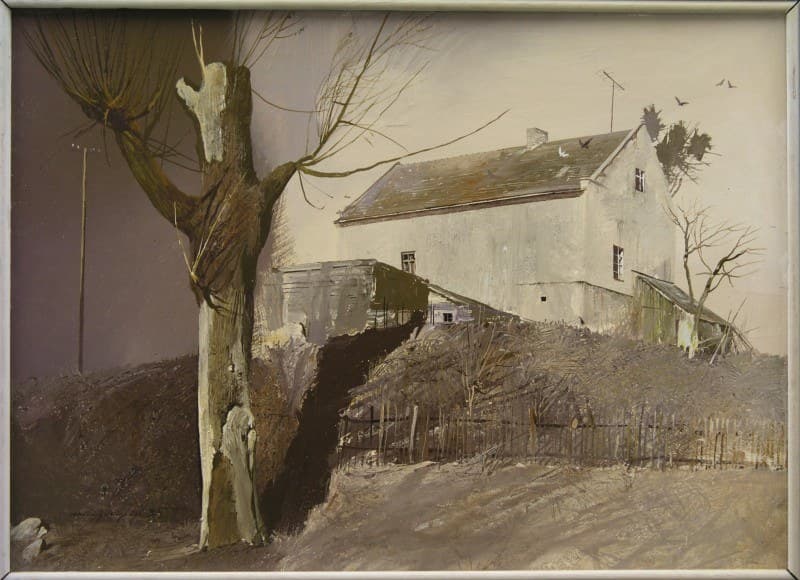
Spring near Lviv
A bare tree with its top lopped off throws a deep shadow across the foreground, while beyond a thin fence stand a two-storey house, outbuildings and a power pole. It is a compact example of the suburban Galician landscape Medvid painted through the mid-1980s.
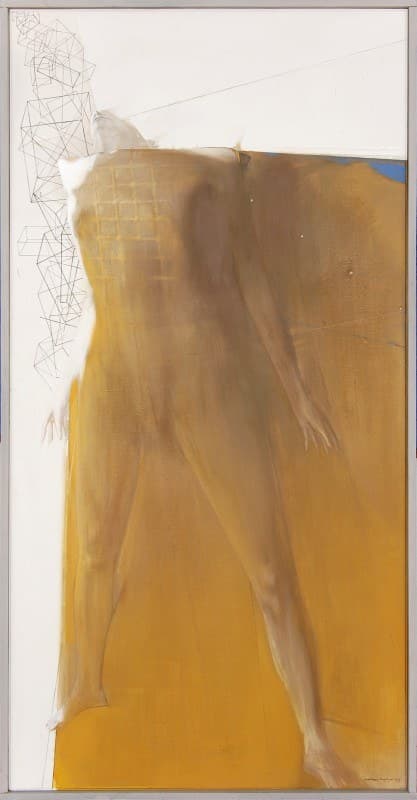
Babylon, from the series Reminiscences. The Prodigal Son
A frontal human figure with its head thrown back is set against an ochre plane broken by blue accents and geometric forms. The canvas belongs to the Prodigal Son strand of the cycle for which Medvid received the Shevchenko National Prize.