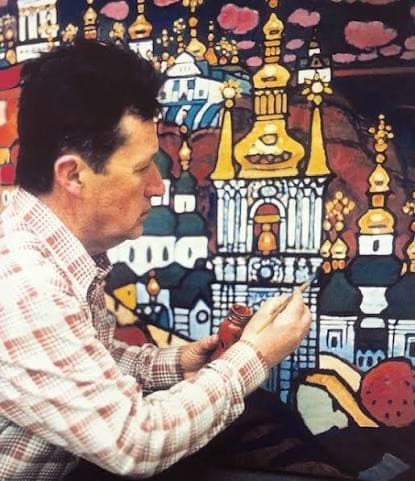
Yurii Khymych
Юрій Химич
1928–2003 · Kamianets-Podilskyi, Khmelnytskyi oblast, Ukraine
Yurii Khymych was a Ukrainian architect turned painter, the outstanding master of the architectural landscape in twentieth-century Ukrainian art. By the late 1950s he was regarded as one of the finest watercolourists in the USSR, before abruptly switching to gouache, the medium of most of his mature work. Trained as an architect and steeped in years of copying church frescoes and mosaics, he painted what he called 'portraits of buildings' — flattened, open-coloured, black-contoured images closer to icons than to conventional views.
Yurii Ivanovych Khymych was born on 12 April 1928 in Kamianets-Podilskyi, the son of a sugar-factory chemical engineer and a schoolteacher. At seventeen he showed his watercolours to the academician Oleksii Shovkunenko, who advised him to enter the architecture faculty of the Kyiv Civil Engineering Institute, where he studied from 1945 to 1950 under the painter and watercolourist Mykhailo Shteinberg. After army service in Sevastopol from 1950 to 1954 — during which his first solo exhibition in 1952 drew praise from Tetiana Yablonska and Mykhailo Derehus — he was invited into the Academy of Architecture of the UkrSSR by its president Volodymyr Zabolotny, working there as a researcher and postgraduate and then, from 1957 to 1964, as senior artist in the history of Ukrainian art department. That post set him to recording the interiors of historic buildings and copying monumental church paintings, and Hryhorii Lohvyn observed that his technically immaculate 'copies' were always interpretations rather than transcriptions. Having reached the summit of watercolour technique in 1957–1958, when experts counted him among the best watercolourists in the Soviet Union, he unexpectedly turned to gouache, which he handled so virtuosically — often on the backs of drawings or on the cheapest paper — that it reads as more painterly than oil, and which proved remarkably durable as the pigment sank into the porous stock. He taught at the Kyiv Civil Engineering Institute from 1964 to 1985, becoming a docent and then acting professor of drawing and painting, and from 1984 at the Kyiv State Art Institute, now the National Academy of Fine Arts and Architecture, where he was made professor in 1991 and wrote his own methodology for teaching drawing to architects. Scholars divide his work into an early watercolour period, a phase of formal experiment in the first half of the 1960s, and a mature period from the mid-1960s of contemplative, symbolic realism; his exposure to icon painting and to the frescoes and mosaics of Saint Sophia in Kyiv and the wooden Church of the Holy Spirit at Potelych gave him the symbolic generalisation and the black outlines that define his mature style. A member of the National Union of Architects from 1955 and of the National Union of Artists from 1962, and an Honoured Artist and Honoured Architect of Ukraine, he held solo exhibitions across Ukraine, Russia, Georgia, Armenia, Lithuania, Hungary, Finland and the United States; his triptych 'Independence Day' hangs in the United States Capitol, and his work is held by the National Art Museum of Ukraine and the Museum of the History of Kyiv. He died in Kyiv on 23 July 2003. Ukrposhta reproduced two of his paintings on postage stamps in 2005 as part of the 'Kyiv through Artists' Eyes' series.
Art Movements
Modernism
Modernism was a radical, early-to-mid-20th-century cultural movement that broke with traditional artistic, literary, and social forms to align with a rapidly industrializing world. Characterized by experimentation, abstraction, and individualism, it sought new modes of expression to address themes of alienation and social change following World War I. Rejection of Tradition: Modernists rejected Victorian morality, academic art, and realistic depictions of subjects, seeking to "make it new". Experimentation: A shift towards abstraction in art (e.g., Cubism) and new techniques in literature, such as stream of consciousness (e.g., Virginia Woolf, James Joyce). Key Themes: Focused on subjectivity, alienation, the fragmentation of reality, and the quest for new meaning. Architecture & Design: Marked by minimalism, functionalism, and the use of industrial materials, famously summarized by Le Corbusier’s "a building is a machine for living in". Time Period: Roughly 1890s–1960s, emerging in Europe and America as a response to urbanization and technological advances.
Explore movement →1880s–1910sSymbolism
A late nineteenth- and early twentieth-century movement that turned away from the documentary aims of realism toward myth, allegory, dream and inner experience. In Ukraine it arrived through Kyiv, Poltava, Kharkiv and Lviv art circles and through artists trained in Munich, Paris and St Petersburg, and it fed directly into Ukrainian Art Nouveau and early modernism. Ukrainian symbolists favoured antique and folk mythology, ritual and allegorical figure compositions over contemporary social subjects.
Explore movement →mid-1950s – 1970sSixtiers (Shistdesiatnyky)
A generation of Ukrainian artists, writers and intellectuals who emerged during the post-Stalin Thaw and pushed back against imposed Socialist Realism by reconnecting with Ukrainian folk form, Byzantine and Cossack-era sources, and European modernism. Centred in Kyiv on the Club of Creative Youth 'Suchasnyk' (founded 1959–62), the circle included Alla Horska, Opanas Zalyvakha, Halyna Sevruk, Liudmyla Semykina and Veniamin Kushnir. Most were expelled from official structures, blacklisted or imprisoned after the 1965 and 1972 waves of arrests, and much of their work was destroyed or hidden until the late 1980s.
Explore movement →Works by Yurii Khymych
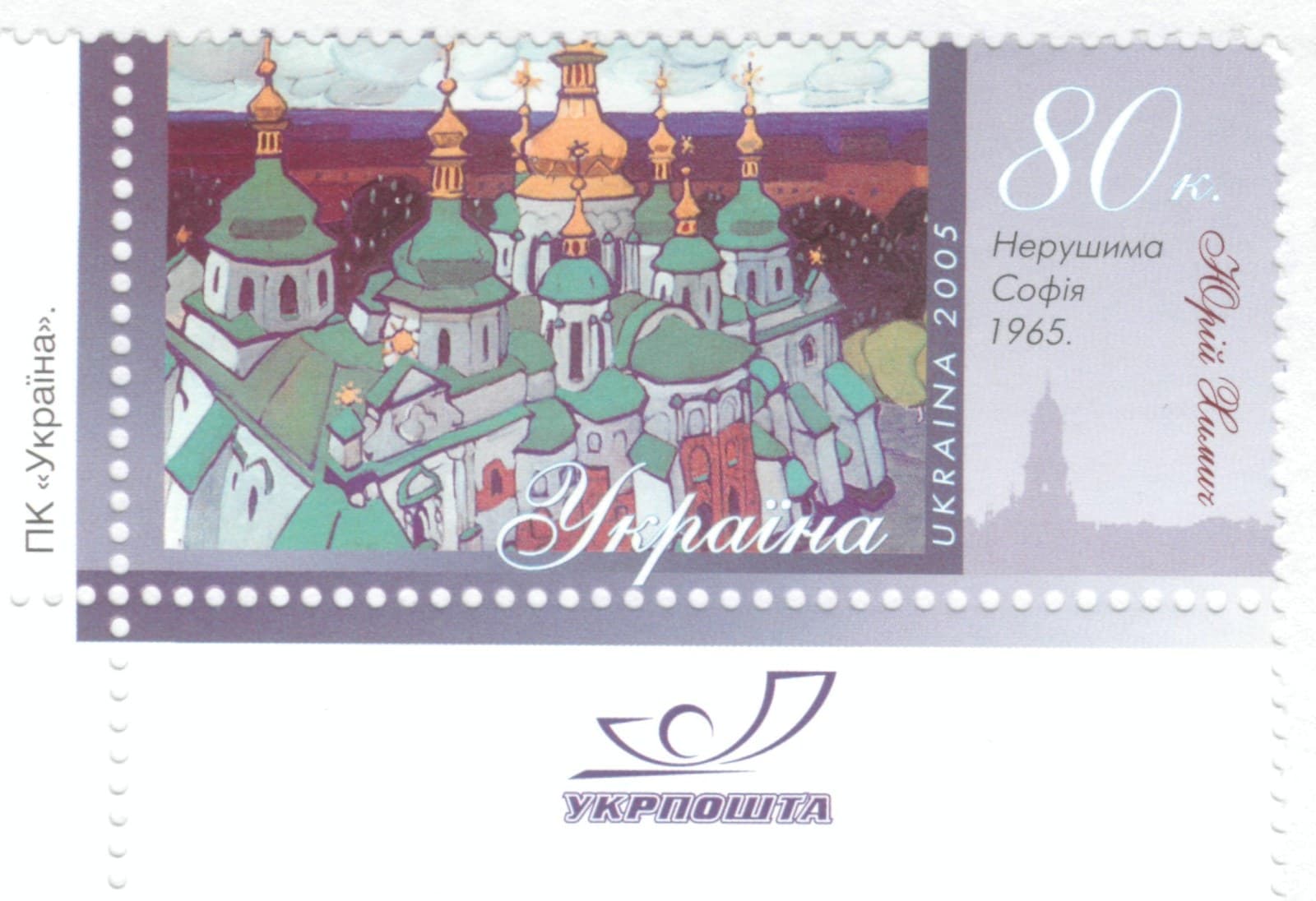
The Indestructible Sophia of Kyiv
Saint Sophia Cathedral rendered in Khymych's mature manner of open colour and heavy black contour, the title borrowed from the ancient epithet of the Kyivan cathedral. Ukrposhta reproduced the painting on an 80-kopiyka stamp in 2005.
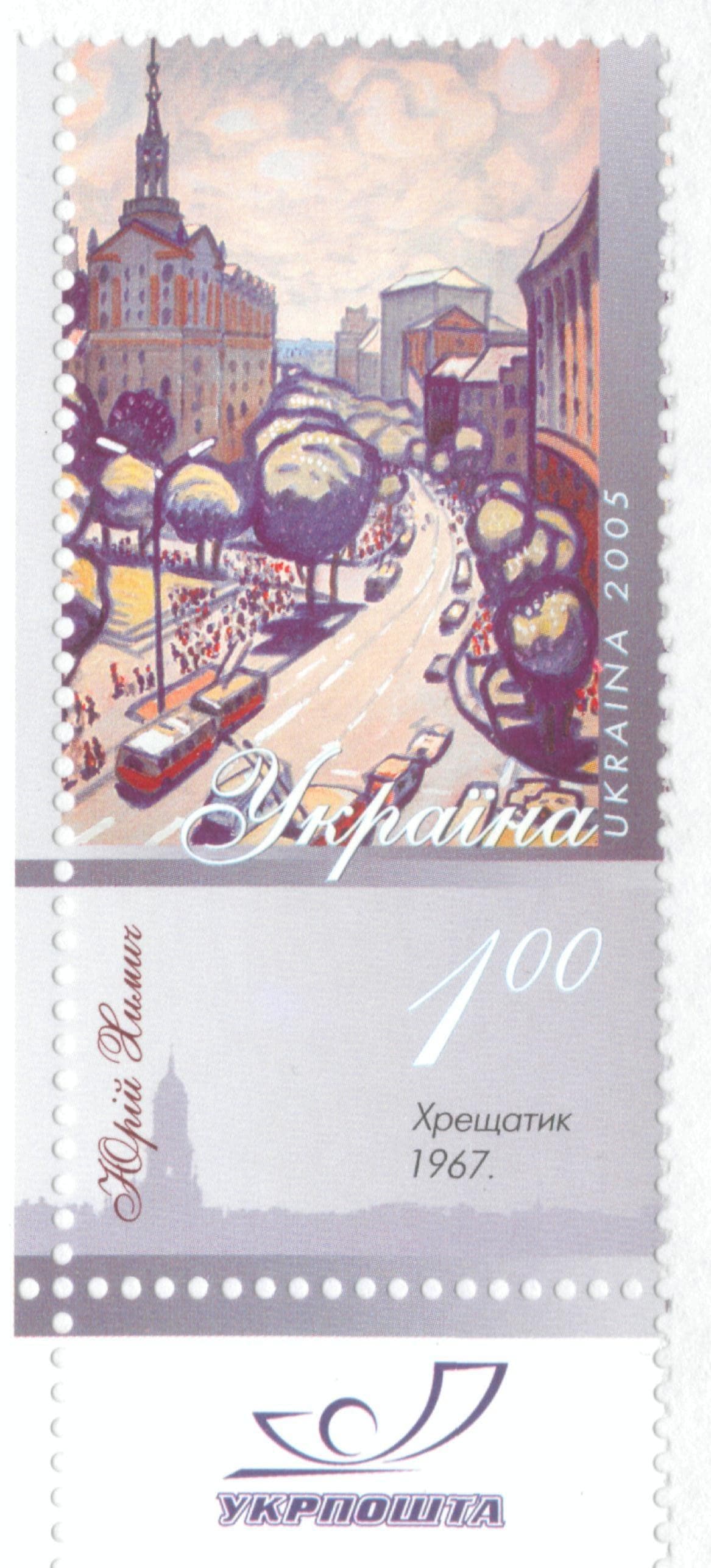
Khreshchatyk
Kyiv's main avenue seen as a stacked, frontal composition of post-war facades — one of the city subjects that made Khymych's reputation as a painter of 'portraits of buildings'. Reproduced by Ukrposhta on a 2005 stamp.