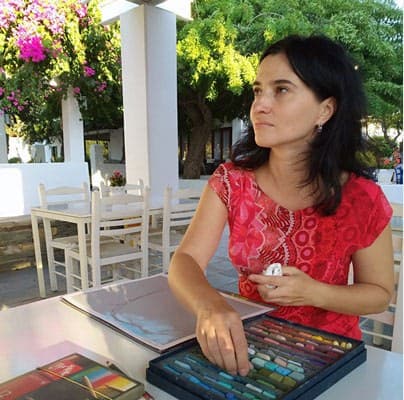
Vira Kavura is a Kyiv-based artist who works almost exclusively in soft pastel, and mainly with flowers. She paints from live bouquets in natural light, building each composition around a dominant bloom, and has produced more than three hundred realist floral pastels. She is an associate artist of Unison Colour and teaches pastel technique through video courses and international workshops.
Vira (Vera) Kavura lives and works in Kyiv. She drew from childhood and studied at art school and at the studio of the National Union of Artists of Ukraine, alongside a degree in international economics; she turned to soft pastel as her principal medium in 2017. Her subject is flowers — peonies, poppies, dahlias, chrysanthemums, asters, wildflowers — treated as a part of wild nature rather than as decorative arrangement, and she works strictly from a living bouquet under natural light, choosing and building the arrangement herself before painting begins. Her method treats the bouquet as a visual system: a dominant flower defines the structure, mass is built through contrasts of scale, and grasses and branches balance the composition. She often works on Colourfix and other coloured pastel papers, deliberately leaving areas of bare support to carry the atmosphere of the picture. Kavura is an associate artist of the British pastel maker Unison Colour, and has built a large international following through Instagram and YouTube; she teaches through Zoom classes, filmed courses for PaintTube.tv ("Realistic Flowers in Pastel", "Painting the Flowers of Ukraine") and residential intensives abroad, including a spring pastel intensive in Rimini, Italy. Her paintings are sold directly through her own shop and are held in private collections internationally. Her stated aim is simply to make the viewer smile and to record what she calls the real miracle of nature.
Portrait: photograph sourced from kavura-art.com. © the photographer / rights holder; shown for editorial purposes. Contact us for attribution or removal.
Art Movements
Realism
Realism is an artistic movement that sought to depict reality as accurately and objectively as possible, holding that the purpose of art is to reflect all aspects of existence, rather than merely its idealized representation. The term was introduced by the French literary critic Jules Champfleury in the 1850s to denote art that opposed Romanticism and Academicism. In the visual arts, the significance of Realism as a style is quite controversial, and its boundaries are undefined. In a narrower sense, realism is understood as positivism, a movement in the visual arts of the second half of the 19th century. One of the first realists was the French artist Gustave Courbet (1819–1877), who opened his solo exhibition “The Pavilion of Realism” in Paris in 1855. Before him, artists of the Barbizon School—Théodore Rousseau, Jean-François Millet, and Jules Breton—worked in a realistic style. In the 1870s, realism split into two main movements: naturalism and impressionism. In contemporary painting, realism borders on the grotesque and anti-glamour.
Explore movement →1991–presentContemporary Ukrainian Painting
Painting made in independent Ukraine, from the 1991 declaration of independence onward. It is pluralist rather than programmatic: plein-air landscape and psychological portraiture continue alongside conceptual, minimalist and symbolist strands, with a marked turn after 2014 and especially after 2022 toward wartime subjects, national memory and the vernacular Ukrainian village.
Explore movement →Works by Vira Kavura
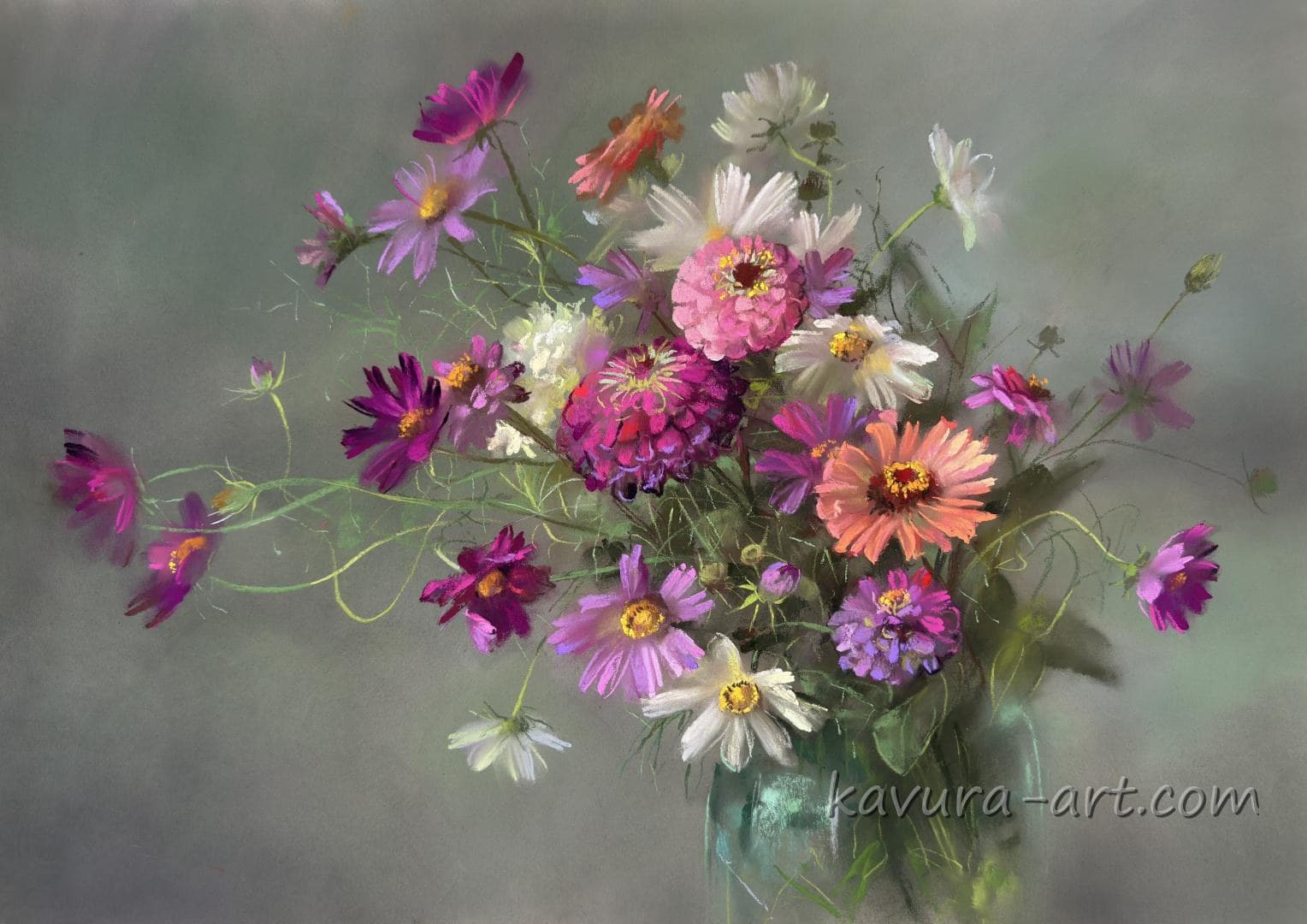
Cosmos and Zinnias
A late-summer bouquet of cosmos and zinnias painted from life, typical of Kavura's high-key realist pastel handling.
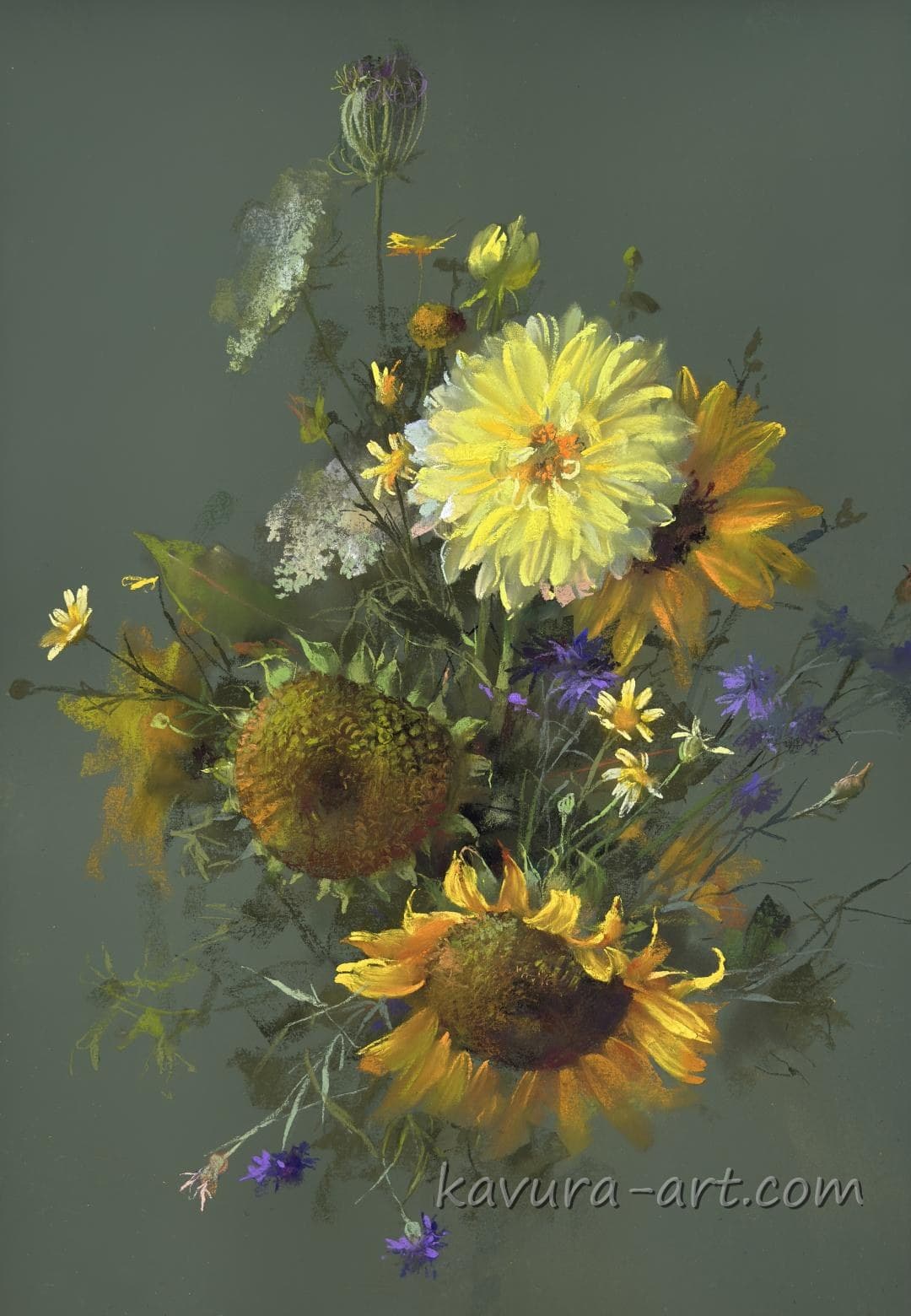
The Warmest Days
A vertical summer bouquet in warm light, one of the artist's recent studio pastels painted from a live arrangement.
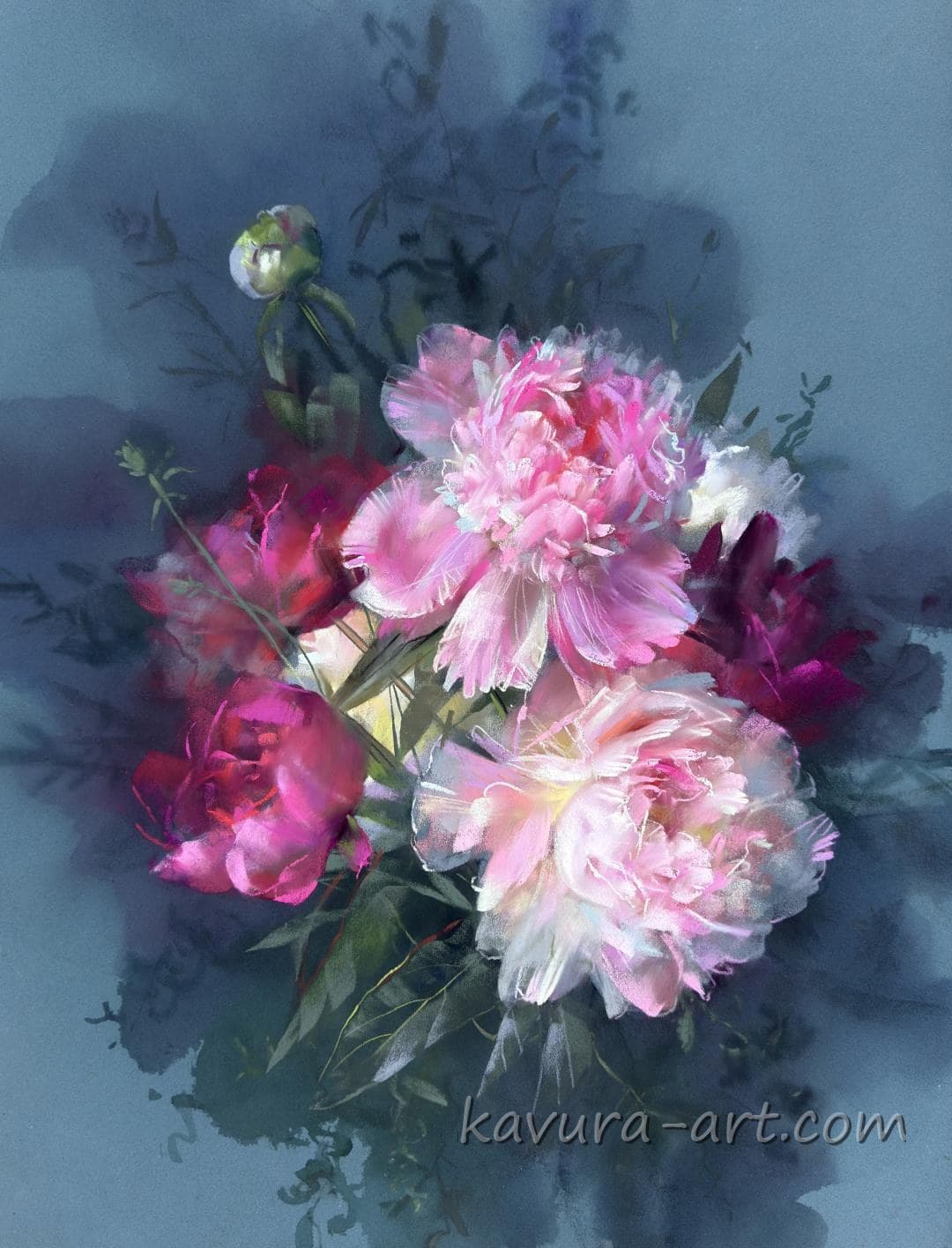
Blooming Haze
A softly diffused floral mass in which Kavura lets the coloured pastel paper show through to create atmosphere.
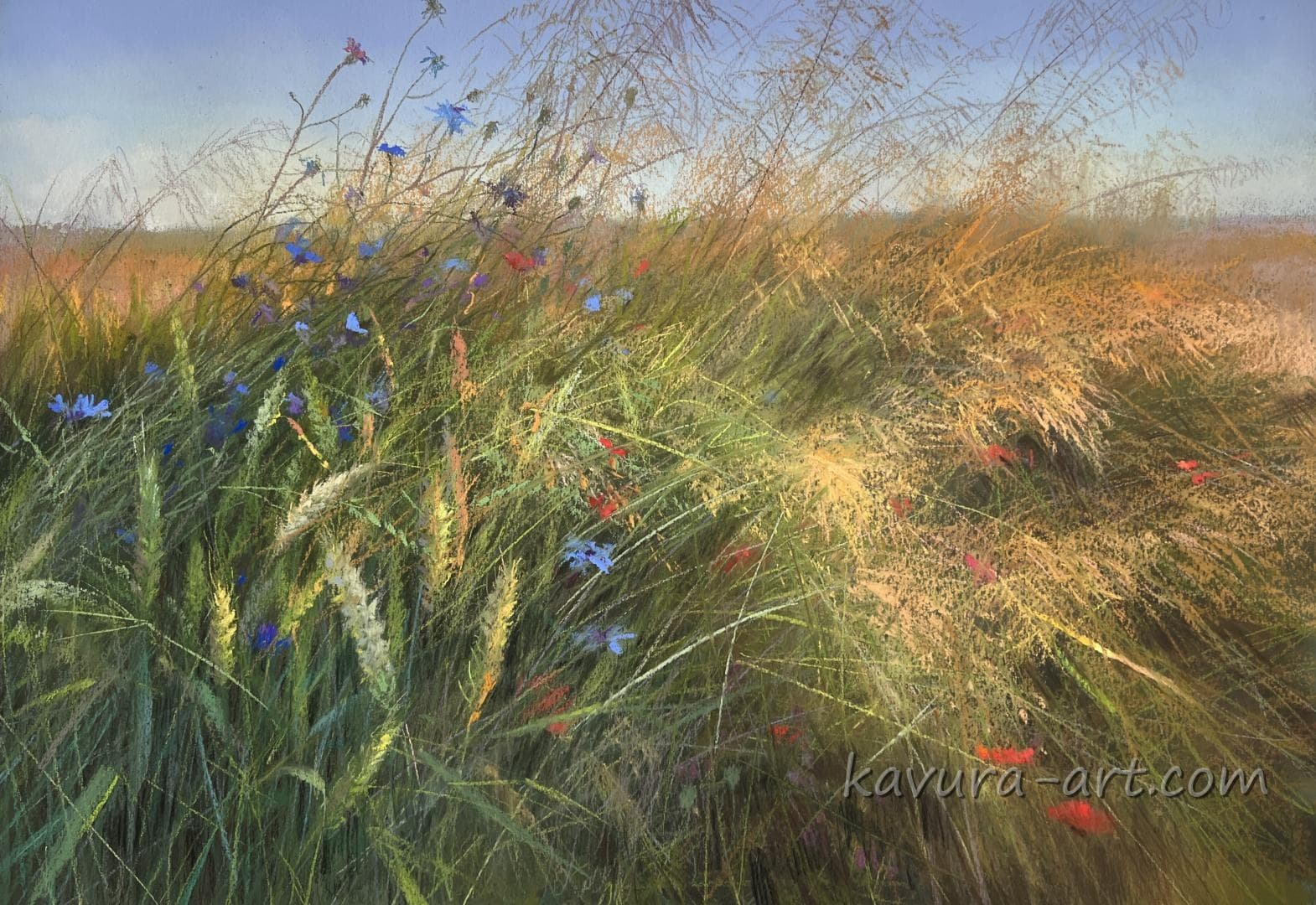
Fields of Ukraine
A field-flower pastel from the artist's own gallery, and one of the few of her works whose title names her country directly. Neither the year nor the dimensions are published.