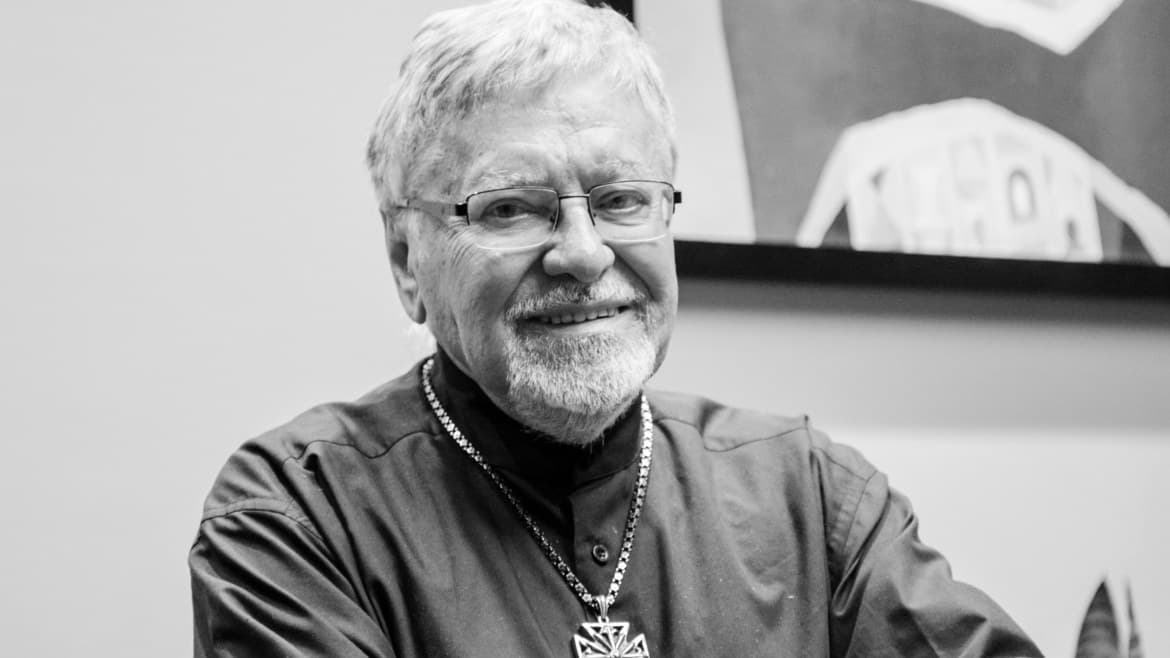
Oleksandr Dubovyk is a Ukrainian painter, printmaker, monumental artist and writer on art, born in Kyiv in 1931 and still working there. A leading figure of the Kyiv artistic underground of the 1960s–80s, he moved from academic training through the austere realism of the Thaw into an abstract-symbolist language of his own signs — the Bouquet, the Triumphator, the Phantom, the Tree of Life. His work is held by the National Art Museum of Ukraine, the Zimmerli Art Museum's Dodge Collection and museums in Germany, Iran and the USA.
Oleksandr Mykhailovych Dubovyk was born in Kyiv on 1 August 1931. His father, the poet Mykhailo Dubovyk, a member of the literary association Pluh, was arrested in 1941 on charges of counter-revolutionary activity and shot; he was posthumously rehabilitated in 1955. Dubovyk trained at the Taras Shevchenko Secondary Art School in Kyiv from 1948 to 1950 under Hennadii Titov, then at the Kyiv State Art Institute from 1951 to 1957 under Titov, Mykhailo Khmelko and Serhii Hryhoriev, graduating with the diploma canvas "Julius Fučík". He taught painting and drawing at the Kyiv College of Applied Art from 1959 to 1962 and worked in the newly opened Kyiv creative studios of the USSR Academy of Arts from 1962 to 1965. Canvases such as "By the Blue Shield" (1964), "Nuclear Physicists" (1963) and "Operation" (1966) place his early maturity squarely in the austere style of the Ukrainian 1960s, but with "Bouquet" of 1966 the flower collapsed into a sign — a circle and a square — and became the founding element of an entirely personal semantic system. From there he built a lexicon of recurring symbols: the Triumphator, the Phantom, the Tree of Life, the Prophet, and marks of movement, light, memory and transformation, developed in cycles titled Carnival, Feast, Dialogue, Triumphators and Bouquet, and recorded across decades of large mixed-media albums. He called the result "suggestive realism" — a compressed, contradictory and polysemous reality — and its construction of space and colour owes as much to Matiushyn and Malevych as to Orthodox iconography and Ukrainian folk chromatics. He worked extensively in monumental media, including the mosaic "World of Technology" at the Kyiv House of the Young Technician (1980), the stained glass "Wind of Wandering" and "Carnival" at the Voskhod sanatorium in Feodosia (1983, 1988), windows for the New Apostolic Church in Kyiv (1996) and chapel decoration at Berre-les-Alpes in France (1996). A member of the Union of Artists since the late 1950s and head of the creative association Pohliad from 1987, he has held around fifty solo exhibitions since 1984 in Ukraine, Germany, France, the USA, Iran, Romania and the former Yugoslavia. In 2024 he received the presidential distinction National Legend of Ukraine, and in the summer of 2026, at ninety-four, the Ukrainian House in Kyiv mounted "Labyrinths of Meanings", the largest retrospective ever devoted to him, with more than 250 works.
Portrait: photograph sourced from stedleyart.com. © the photographer / rights holder; shown for editorial purposes. Contact us for attribution or removal.
Art Movements
Austere Art
Minimalism & Simplicity: Austere art is pared down, stripping away unnecessary decoration to focus on pure, sometimes geometric, form. Restrained Color Palettes: The style often uses limited, monochromatic, or muted color schemes, such as gray, black, or white, to highlight texture and form rather than vibrant color. Focus on Structure: Compositions are often highly disciplined, thoughtful, and precise.Somber Mood: It can communicate a "cold," "grave," or, in some cases, "spiritual" tone, as seen in the work of filmmakers like Robert Bresson or painter Pieter Saenredam. "Truth to Materials": Influenced by movements like the Arts and Crafts, it emphasizes honesty in the material's natural state.
Explore movement →Modernism
Modernism was a radical, early-to-mid-20th-century cultural movement that broke with traditional artistic, literary, and social forms to align with a rapidly industrializing world. Characterized by experimentation, abstraction, and individualism, it sought new modes of expression to address themes of alienation and social change following World War I. Rejection of Tradition: Modernists rejected Victorian morality, academic art, and realistic depictions of subjects, seeking to "make it new". Experimentation: A shift towards abstraction in art (e.g., Cubism) and new techniques in literature, such as stream of consciousness (e.g., Virginia Woolf, James Joyce). Key Themes: Focused on subjectivity, alienation, the fragmentation of reality, and the quest for new meaning. Architecture & Design: Marked by minimalism, functionalism, and the use of industrial materials, famously summarized by Le Corbusier’s "a building is a machine for living in". Time Period: Roughly 1890s–1960s, emerging in Europe and America as a response to urbanization and technological advances.
Explore movement →Works by Oleksandr Dubovyk
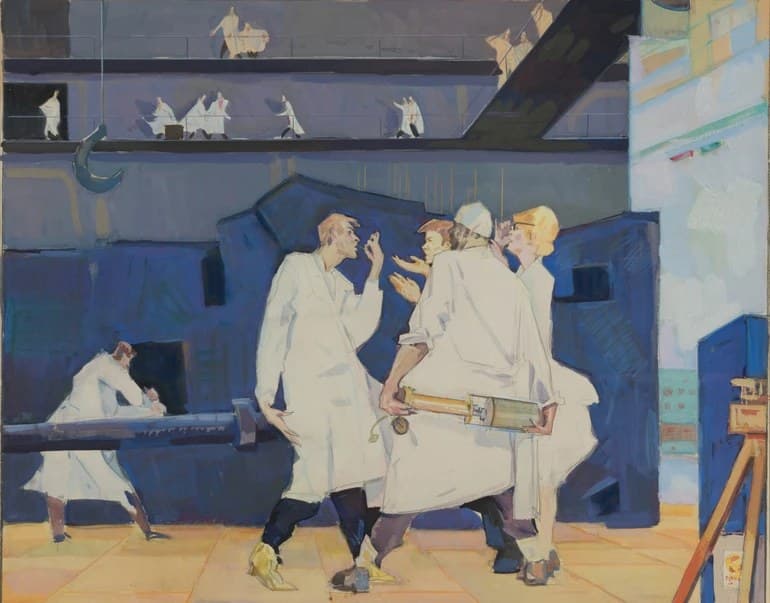
Nuclear Physicists
A group composition of scientists in the flattened, graphic manner of the Thaw-era austere style, from the period when Dubovyk was still working within an approved Soviet subject range. It marks the last phase before his turn to abstraction.
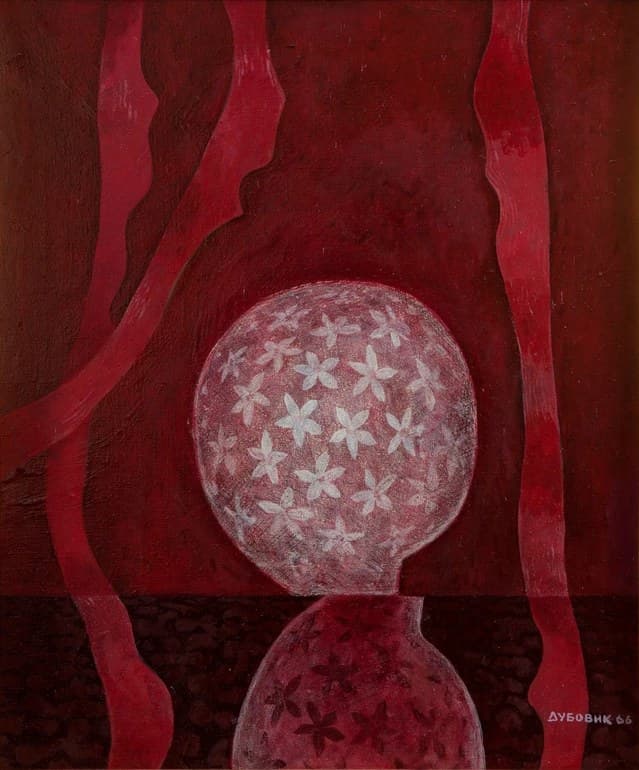
Bouquet
The pivotal canvas of Dubovyk's career, in which the flower is reduced to a circle and a square and stops being a depiction to become a sign. Every later cycle in his work descends from this reduction.
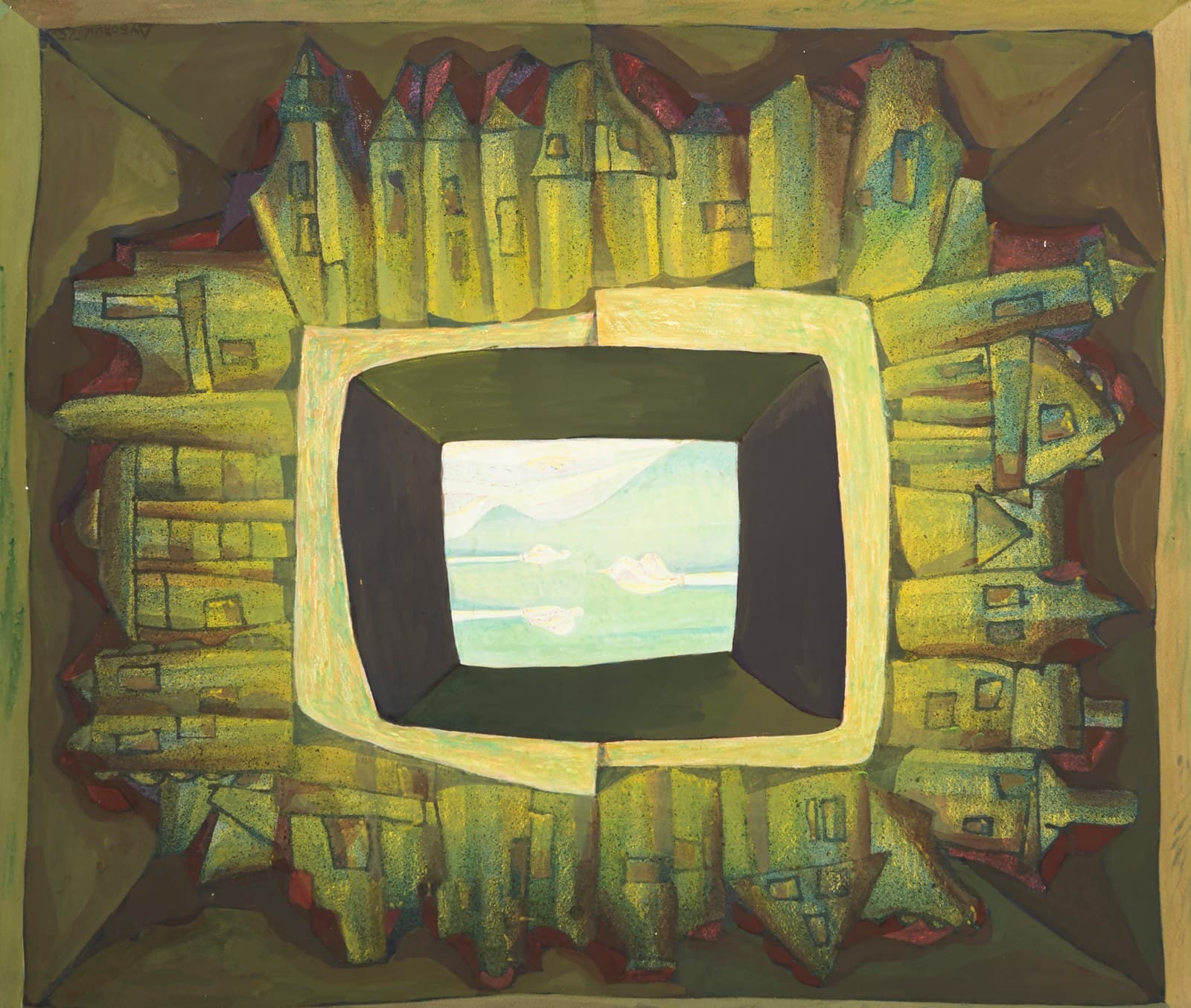
Television in the Night
A tempera sheet from the mid-1970s in which a glowing rectangle in the dark becomes another of Dubovyk's ambiguous signs, part image and part window. It comes from the group of works Norton Dodge smuggled out of the USSR.
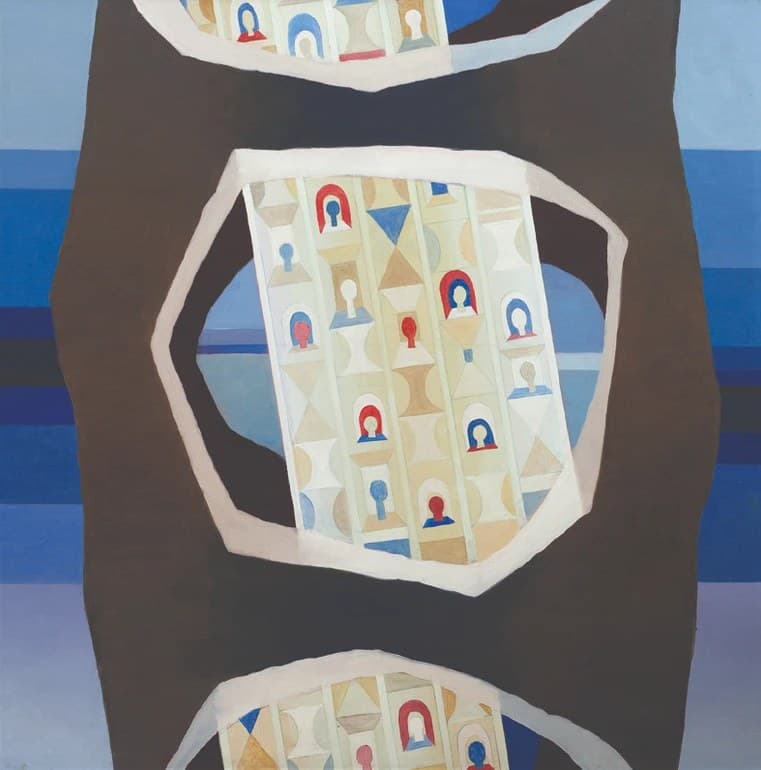
Tablets
A square canvas from Dubovyk's underground years, in which his invented signs are laid out like inscriptions on stone tablets. The title makes explicit the quasi-scriptural status he gave his own pictorial alphabet.
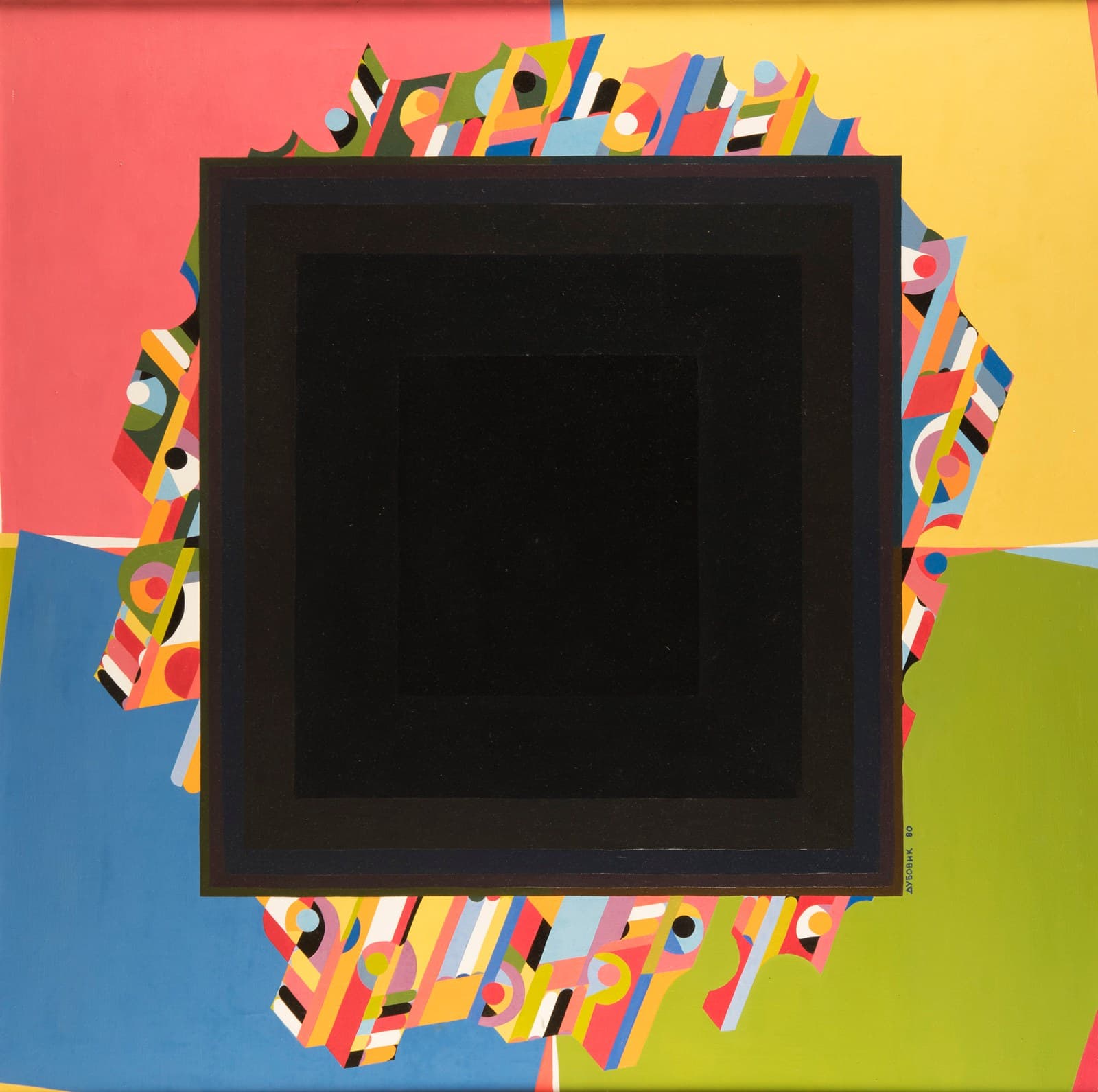
Black Square
A large square canvas answering Malevych directly, painted at the height of Dubovyk's nonconformist period and acquired by Norton Dodge for his collection of unofficial Soviet art. Dubovyk's debt to Malevych's construction of space runs through the whole series.
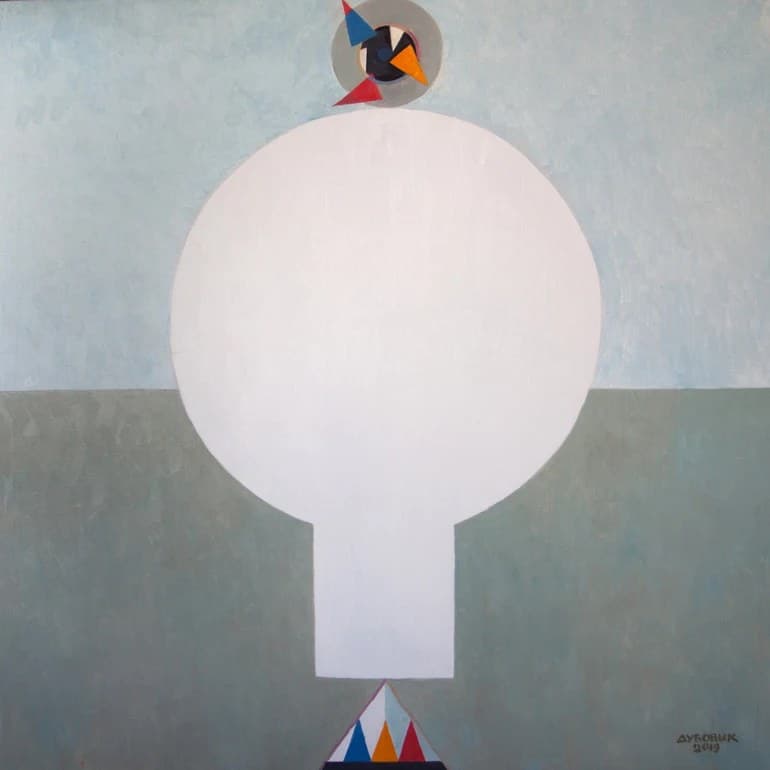
Mandala
A large late canvas in which Dubovyk's lifelong vocabulary of signs is organised into a single centred, radiating figure. It shows the explicitly meditative and cosmological turn of his work past the age of eighty.