Nataliia Verhun
Наталія Вергун
1938–2026 · Okhtyrka, Sumy oblast, Ukraine
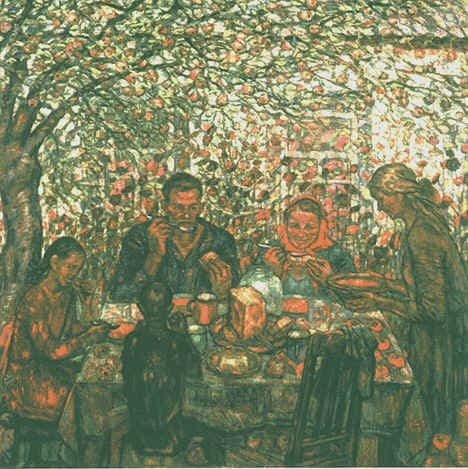
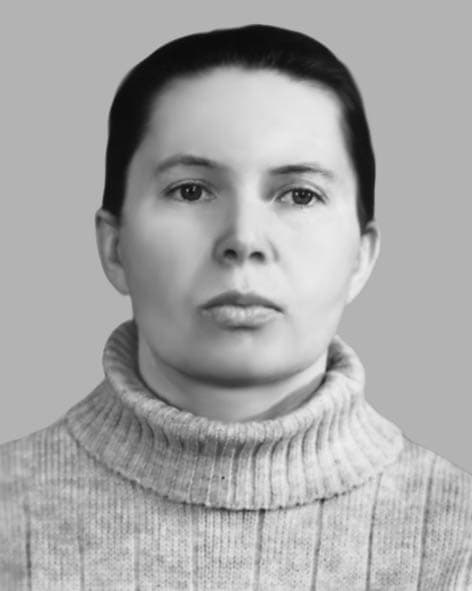
Nataliia Verhun was a Ukrainian painter based in Kharkiv, People's Artist of Ukraine (1997) and the daughter of the poet Ivan Vyrhan. Trained at the Repin Institute in Leningrad under Andrei Mylnikov, she devoted her career to the life of the Ukrainian village — harvests, field meals, self-portraits and seasonal still lifes. The Kharkiv Art Museum holds the largest body of her work, enlarged by a gift of some 400 pieces in 2025.
Nataliia Ivanivna Verhun was born on 2 July 1938 in Okhtyrka, in what is now Sumy oblast; her father was Ivan Onykiiovych Vyrhan (Verhun), a Ukrainian poet and translator who survived both Stalinist repression and the Second World War. She studied at the Kharkiv Art College from 1953 to 1958 under Mykola Slipchenko, then at the Repin Institute of Painting, Sculpture and Architecture in Leningrad, graduating in 1964 from the studio of Andrei Mylnikov, and continued in the USSR Academy of Arts' postgraduate creative workshop under Mylnikov from 1966 to 1968. She taught at the Kyiv Art Institute in 1964–1966 and at the Kharkiv Art and Industrial Institute from 1968 to 1978, after which she worked independently as an artist. A member of the Kharkiv branch of the National Union of Artists of Ukraine from 1971, she exhibited from the mid-1960s in republican, all-Union and international shows, with solo exhibitions in Kharkiv (1984–85, 1998–99, 2008, 2018), Kyiv (1987, 1999) and Krasnohrad (1987). Her subjects were drawn almost entirely from rural Ukraine — genre canvases, still-life cycles such as 'Seasons of the Year. Still Lifes' (1970–1983) and the later 'Poetic Ukraine' (1993–1996) — and critics singled out the optimism, lyricism and refined tonal control of her painting. She was named an Honoured Artist of Ukraine in 1991 and People's Artist of Ukraine in 1997, and received a municipal prize from the city of Kharkiv. Her work is held by the Kharkiv Art Museum, which mounted a jubilee retrospective in September 2018 and received a gift of roughly four hundred works from her in 2025, as well as by the National Art Museum of Ukraine, the Chernihiv Regional Art Museum and museums in Kremenets, Krasnohrad and Izmail. She died in Kharkiv on 30 March 2026.
Art Movements
Realism
Realism is an artistic movement that sought to depict reality as accurately and objectively as possible, holding that the purpose of art is to reflect all aspects of existence, rather than merely its idealized representation. The term was introduced by the French literary critic Jules Champfleury in the 1850s to denote art that opposed Romanticism and Academicism. In the visual arts, the significance of Realism as a style is quite controversial, and its boundaries are undefined. In a narrower sense, realism is understood as positivism, a movement in the visual arts of the second half of the 19th century. One of the first realists was the French artist Gustave Courbet (1819–1877), who opened his solo exhibition “The Pavilion of Realism” in Paris in 1855. Before him, artists of the Barbizon School—Théodore Rousseau, Jean-François Millet, and Jules Breton—worked in a realistic style. In the 1870s, realism split into two main movements: naturalism and impressionism. In contemporary painting, realism borders on the grotesque and anti-glamour.
Explore movement →mid-1950s – 1970sSixtiers (Shistdesiatnyky)
A generation of Ukrainian artists, writers and intellectuals who emerged during the post-Stalin Thaw and pushed back against imposed Socialist Realism by reconnecting with Ukrainian folk form, Byzantine and Cossack-era sources, and European modernism. Centred in Kyiv on the Club of Creative Youth 'Suchasnyk' (founded 1959–62), the circle included Alla Horska, Opanas Zalyvakha, Halyna Sevruk, Liudmyla Semykina and Veniamin Kushnir. Most were expelled from official structures, blacklisted or imprisoned after the 1965 and 1972 waves of arrests, and much of their work was destroyed or hidden until the late 1980s.
Explore movement →