Mykola Ovsiiko
Микола Овсійко
b. 1954 · Bilmachivka, Ichnia district (now Pryluky district), Chernihiv Oblast, Ukraine
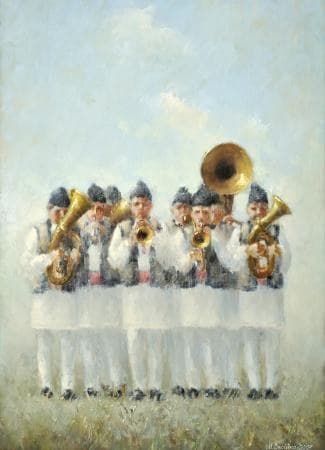
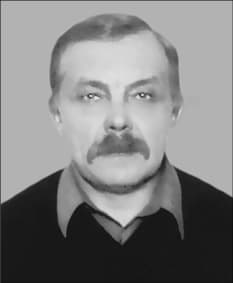
Mykola Ovsiiko (b. 1954, Chernihiv Oblast) is an Odesa-based Ukrainian painter working almost entirely in landscape and still life. His pictures are noted for their quiet, narrative undercurrent and unorthodox painterly solutions rather than straight description. He was made a Merited Artist of Ukraine in 2018.
Mykola Serhiiovych Ovsiiko was born on 22 August 1954 in the village of Bilmachivka in the Ichnia (now Pryluky) district of Chernihiv Oblast. He trained at the Odesa Theatre Art-and-Technical College, graduating in 1973 under L. Alshyts and V. Babynina, and then spent sixteen years as a designer in Odesa's commercial-advertising and art-design combine (1973–1989), while working as an independent artist from 1975. He joined the National Union of Artists of Ukraine in 1993 and was named a Merited Artist of Ukraine in 2018. Landscape and still life are his two constant genres, handled — in the words of his Encyclopedia of Modern Ukraine entry — with poetic and narrative undertones and original painterly solutions; critics writing about him in the Odesa press repeatedly reached for the vocabulary of calm and stillness, with articles titled "The calm one seeks" and "A philosophy of tranquillity." He has shown in oblast, all-Ukrainian and international exhibitions since 1975, with a solo show in Berlin in 1994 and a long run of one-man exhibitions in Odesa (1997, 1999, 2000, 2006, 2010, 2012, 2018, 2021), Dnipro (2011) and Yuzhne in Odesa Oblast (2013). His work is held by the Museum of Contemporary Art Odesa, the Korsaks Museum of Contemporary Ukrainian Art in Lutsk, and the Odesa fine art and literary museums. Recurring motifs across his catalogue — moths and butterflies, orchards, wells, lilies of the valley, the sea before and after a storm — give the late work a distinctly rural and elegiac cast.
Art Movements
Realism
Realism is an artistic movement that sought to depict reality as accurately and objectively as possible, holding that the purpose of art is to reflect all aspects of existence, rather than merely its idealized representation. The term was introduced by the French literary critic Jules Champfleury in the 1850s to denote art that opposed Romanticism and Academicism. In the visual arts, the significance of Realism as a style is quite controversial, and its boundaries are undefined. In a narrower sense, realism is understood as positivism, a movement in the visual arts of the second half of the 19th century. One of the first realists was the French artist Gustave Courbet (1819–1877), who opened his solo exhibition “The Pavilion of Realism” in Paris in 1855. Before him, artists of the Barbizon School—Théodore Rousseau, Jean-François Millet, and Jules Breton—worked in a realistic style. In the 1870s, realism split into two main movements: naturalism and impressionism. In contemporary painting, realism borders on the grotesque and anti-glamour.
Explore movement →1991–presentContemporary Ukrainian Painting
Painting made in independent Ukraine, from the 1991 declaration of independence onward. It is pluralist rather than programmatic: plein-air landscape and psychological portraiture continue alongside conceptual, minimalist and symbolist strands, with a marked turn after 2014 and especially after 2022 toward wartime subjects, national memory and the vernacular Ukrainian village.
Explore movement →