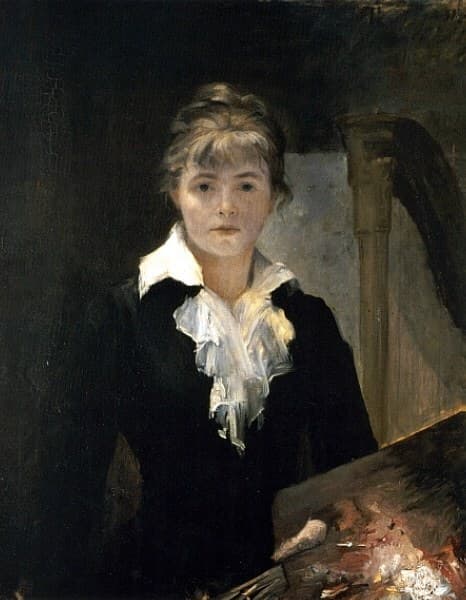
Mariia Bashkirtseva
Марія Башкірцева
1858–1884 · Havrontsi, Poltava county, Poltava Governorate, Russian Empire (now Poltava Oblast, Ukraine)
Mariia Bashkirtseva was a painter, sculptor and diarist born in the village of Havrontsi in Ukraine's Poltava region, who became one of the most talked-about young artists of 1880s Paris. Trained at the Académie Julian and shaped by the naturalism of Jules Bastien-Lepage, she won a Salon gold medal in 1879 and died of tuberculosis at 25. Her early works are today divided between the State Russian Museum and Ukrainian collections in Dnipro and Kharkiv.
Mariia Bashkirtseva was born in 1858 in Havrontsi, Poltava Governorate, into a wealthy landowning family: her father Konstantyn Bashkirtsev led the nobility of the Poltava region and her mother, Mariia Babanina, was a Kharkiv colonel's daughter. Her childhood was spent on the family estates in the Poltava countryside, and in 1870 her mother took her abroad, the family finally settling in Nice in 1872. In Paris she enrolled at the Académie Julian, one of the few academies open to women, and worked with obsessive discipline under the influence of the naturalist painter Jules Bastien-Lepage, whom she nursed in his final illness. She won a gold medal in a student competition in 1879 and exhibited at the Salon in the early 1880s, drawing praise from Anatole France and Émile Zola for canvases about Parisian street children, working women and servants. She died of tuberculosis in Paris in 1884, aged 25, leaving around 150 paintings, some 200 drawings and several sculptures. Her French-language diary, first published in 1887, became one of the most widely read confessional texts of the nineteenth century and secured her posthumous fame across Europe. Many of her canvases were destroyed during the Second World War; the largest surviving group went to St Petersburg, while In the Studio is a centrepiece of the Dnipro Art Museum and At a Book is held in Kharkiv.
Art Movements
Realism
Realism is an artistic movement that sought to depict reality as accurately and objectively as possible, holding that the purpose of art is to reflect all aspects of existence, rather than merely its idealized representation. The term was introduced by the French literary critic Jules Champfleury in the 1850s to denote art that opposed Romanticism and Academicism. In the visual arts, the significance of Realism as a style is quite controversial, and its boundaries are undefined. In a narrower sense, realism is understood as positivism, a movement in the visual arts of the second half of the 19th century. One of the first realists was the French artist Gustave Courbet (1819–1877), who opened his solo exhibition “The Pavilion of Realism” in Paris in 1855. Before him, artists of the Barbizon School—Théodore Rousseau, Jean-François Millet, and Jules Breton—worked in a realistic style. In the 1870s, realism split into two main movements: naturalism and impressionism. In contemporary painting, realism borders on the grotesque and anti-glamour.
Explore movement →Impressionism
Impressionism was a 19th-century French art movement (1870s-1880s) that revolutionized Western art by capturing fleeting moments and the shifting effects of light using visible brushstrokes, open composition, and vibrant colors. Focusing on modern life and landscapes, key artists included Claude Monet, Pierre-Auguste Renoir, Camille Pissarro, and Berthe Morisot. Usage Examples & Characteristics: Plein Air Painting: Painting outdoors to capture natural light, such as Monet’s studies of Rouen Cathedral or haystacks in varying weather conditions. Visible Brushwork: Thick, rapid, or broken brushstrokes intended to convey a sense of motion and the ephemeral nature of a scene. Everyday Subjects: Depicting leisure activities, urban life in Paris, or landscapes rather than historical or mythological scenes. Unusual Visual Angles: Inspired by photography, artists like Degas used candid-style, unconventional framing of subjects, such as dancers or laundresses. "Impressionist Music": A similar approach in music and dance, focusing on mood and atmosphere over rigid structure, with artists like Claude Debussy and Maurice Ravel.
Explore movement →Works by Mariia Bashkirtseva
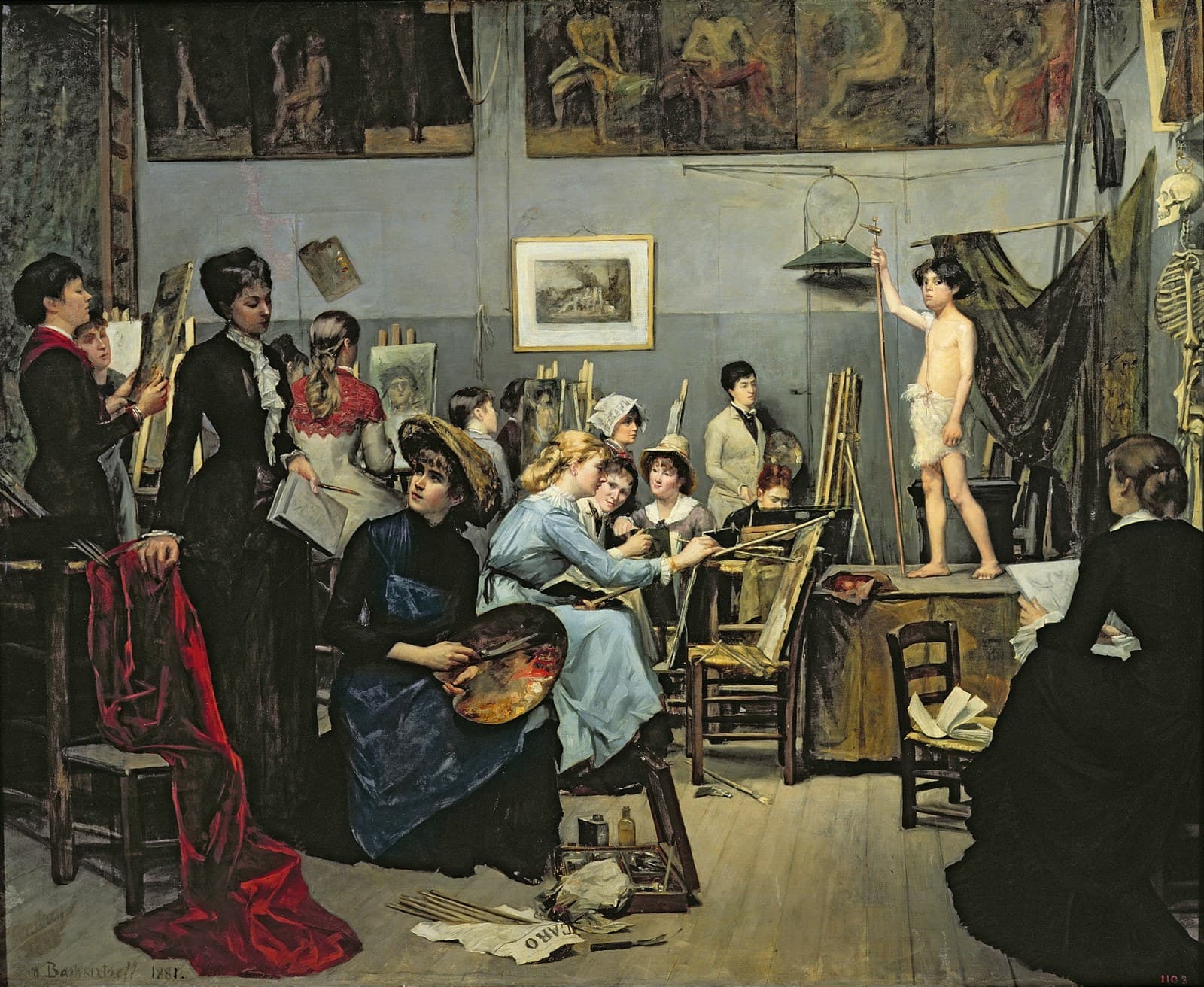
In the Studio
Bashkirtseva's best-known canvas records the women's atelier of the Académie Julian in Paris, with students crowded around a boy model in a room hung with drawings. It is both a group portrait of her fellow women artists and a quiet argument that they belonged in professional training, and it now hangs in Ukraine at the Dnipro Art Museum.
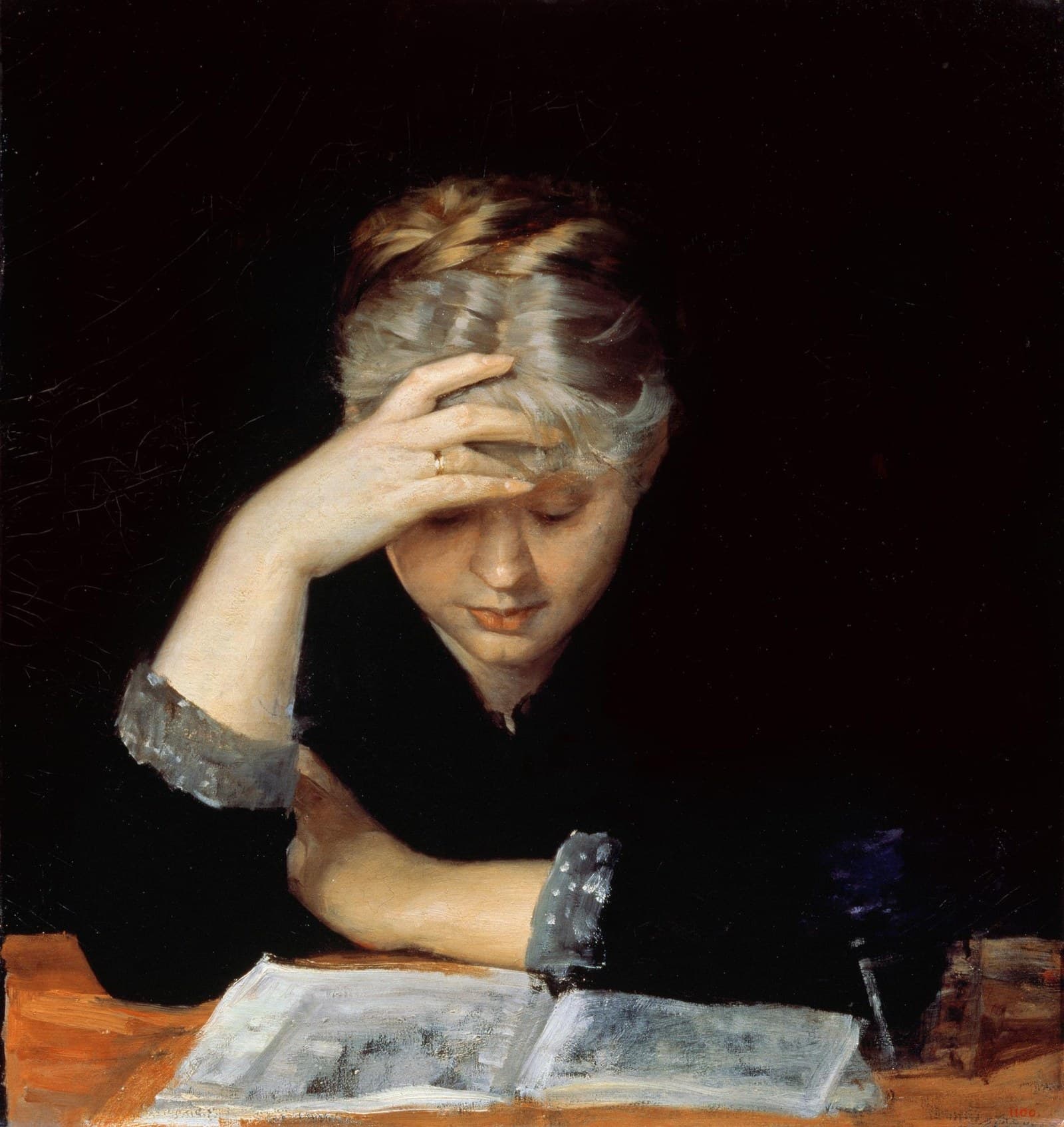
At a Book
A close-focused study of a young woman absorbed in reading, painted in the soft grey-green tonality Bashkirtseva took from Bastien-Lepage. It is one of the few of her canvases preserved in Ukraine, in the collection of the Kharkiv Art Museum.
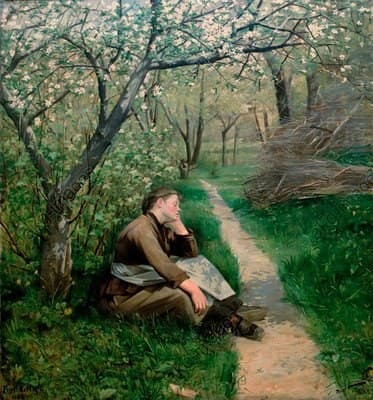
Spring
A large decorative panel, begun from studies made in an old orchard, showing a young woman leaning back against a tree with her eyes closed and a faint smile, wrapped in blossoming apple and peach branches. Bashkirtseva described the idea in her diary as a figure dissolved into a tender green landscape, and painted it in the same muted browns and greens Bastien-Lepage used for his plein-air peasants.
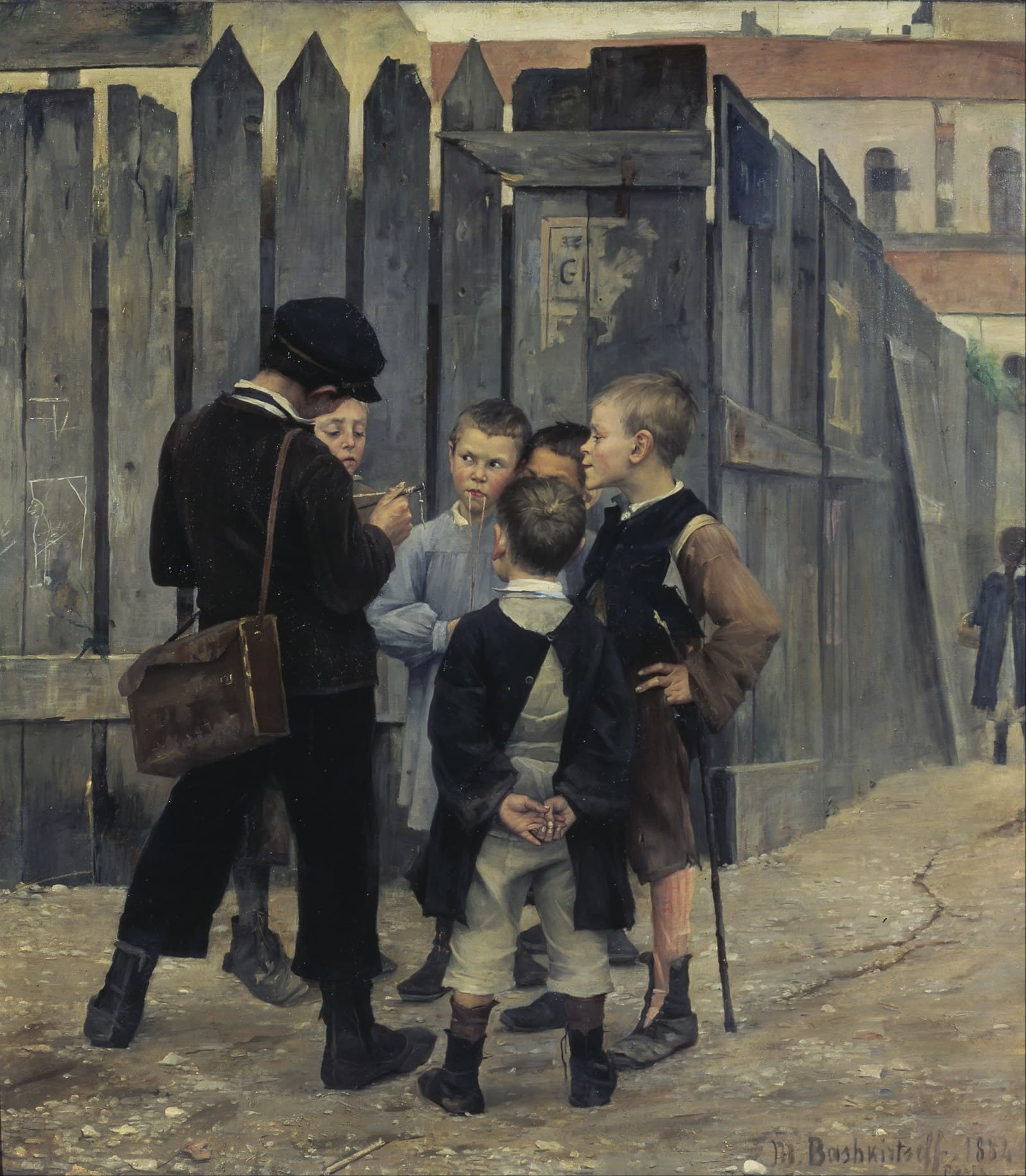
A Meeting
Seven ragged Parisian boys stand conspiring in front of a wooden fence while a girl walks away in the background. Shown at the 1884 Salon and bought for the French state, it is the fullest statement of Bashkirtseva's naturalist interest in the children of the city's poor outskirts.