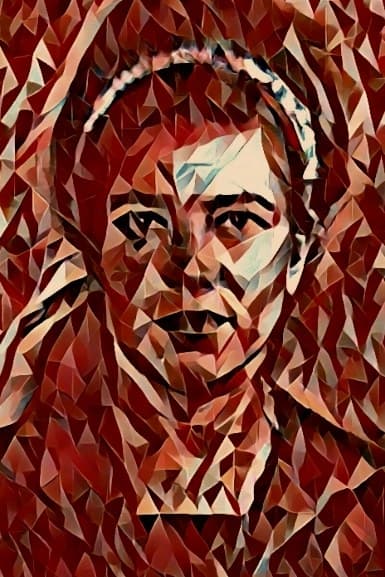
Liubov Panchenko
Любов Панченко
1938–2022 · Bucha, Kyiv Oblast, Ukraine
Liubov Panchenko (1938–2022) was a Ukrainian artist and fashion designer of the Sixtiers generation who worked across clothing design, textile appliqué, embroidery, watercolour, gouache and linocut, always through a Ukrainian ornamental idiom. Blacklisted by the Soviet authorities, she was never admitted to the Union of Artists and neither exhibited nor published for decades. She spent a month under Russian occupation in Bucha in 2022 and died on 30 April that year, aged 84, after starvation and exhaustion.
Liubov Mykhailivna Panchenko was born on 2 February 1938 in the settlement of Bucha in Kyiv Oblast. She completed the embroidery department of the Kyiv School of Applied Arts in the late 1950s, worked in a tailoring workshop, took up linocut, and in 1968 enrolled in the evening graphics course at the Ivan Fedorov Ukrainian Polygraphic Institute. She was employed as an artist-designer at the Project-Design Technology Institute and at the Republican House of Models, and in these years produced watercolour series, clothing models, embroidery patterns, book vignettes and paintings; her embroidery designs were published in the magazine "Radianska Zhinka" and copied across the republic. In the 1960s she attended the Club of Creative Youth "Suchasnyk" and joined its literary section "Brama". She painted pysanky, embroidered national costumes for choirs, collected money for political prisoners serving sentences for "anti-Soviet agitation", and helped revive Christmas carolling and the vertep in Kyiv; in 1964 she made designs for Ukrainian ceremonial linens and decorated walls of the Taras Shevchenko Museum while her colleagues Horska, Semykina, Sevruk and Zalyvakha were making the stained glass «Шевченко. Мати». Despite her professional mastery she was kept outside the Union of Artists and the authorities neither exhibited nor published her; her first substantial showing was a jubilee exhibition of more than 150 works at the National Museum of Ukrainian Literature in 2008, followed by «Світе мій!» at the Hrushevskyi Museum in 2014. She lived in Lisova Bucha and remained there through the Russian occupation of the town in March 2022. According to Bucha's mayor Anatolii Fedoruk she died in hospital on 30 April 2022, in her eighty-fifth year, after a month of starvation in the occupied town; she was buried on 2 May in Bucha's Yablunske cemetery beside her husband, the artist Oleksii Oliinyk. A street in Bucha was renamed for her in 2023 and the National Bank of Ukraine issued a 10-hryvnia commemorative coin in her honour in April 2025. Her works are in private collections and in the Museum of the Sixtiers in Kyiv, and her first retrospective, «Всесвіт Любові», opened at the Museum of the History of Kyiv in February 2025.
Art Movements
Folk Decorative Art
Folk decorative art is the visual language of a community, traditionally created by untrained artisans rather than academic artists. It combines utility with ornament, transforming everyday objects like furniture, textiles, and tools into works of cultural expression.
Explore movement →1910s–1930sUkrainian Graphic Art & Book Design
An early-20th-century renaissance of Ukrainian graphic art, typography, book illustration and state symbolism. Its founding figure Heorhiy Narbut created the visual identity of the modern Ukrainian state.
Explore movement →mid-1950s – 1970sSixtiers (Shistdesiatnyky)
A generation of Ukrainian artists, writers and intellectuals who emerged during the post-Stalin Thaw and pushed back against imposed Socialist Realism by reconnecting with Ukrainian folk form, Byzantine and Cossack-era sources, and European modernism. Centred in Kyiv on the Club of Creative Youth 'Suchasnyk' (founded 1959–62), the circle included Alla Horska, Opanas Zalyvakha, Halyna Sevruk, Liudmyla Semykina and Veniamin Kushnir. Most were expelled from official structures, blacklisted or imprisoned after the 1965 and 1972 waves of arrests, and much of their work was destroyed or hidden until the late 1980s.
Explore movement →Works by Liubov Panchenko
Decorative compositions
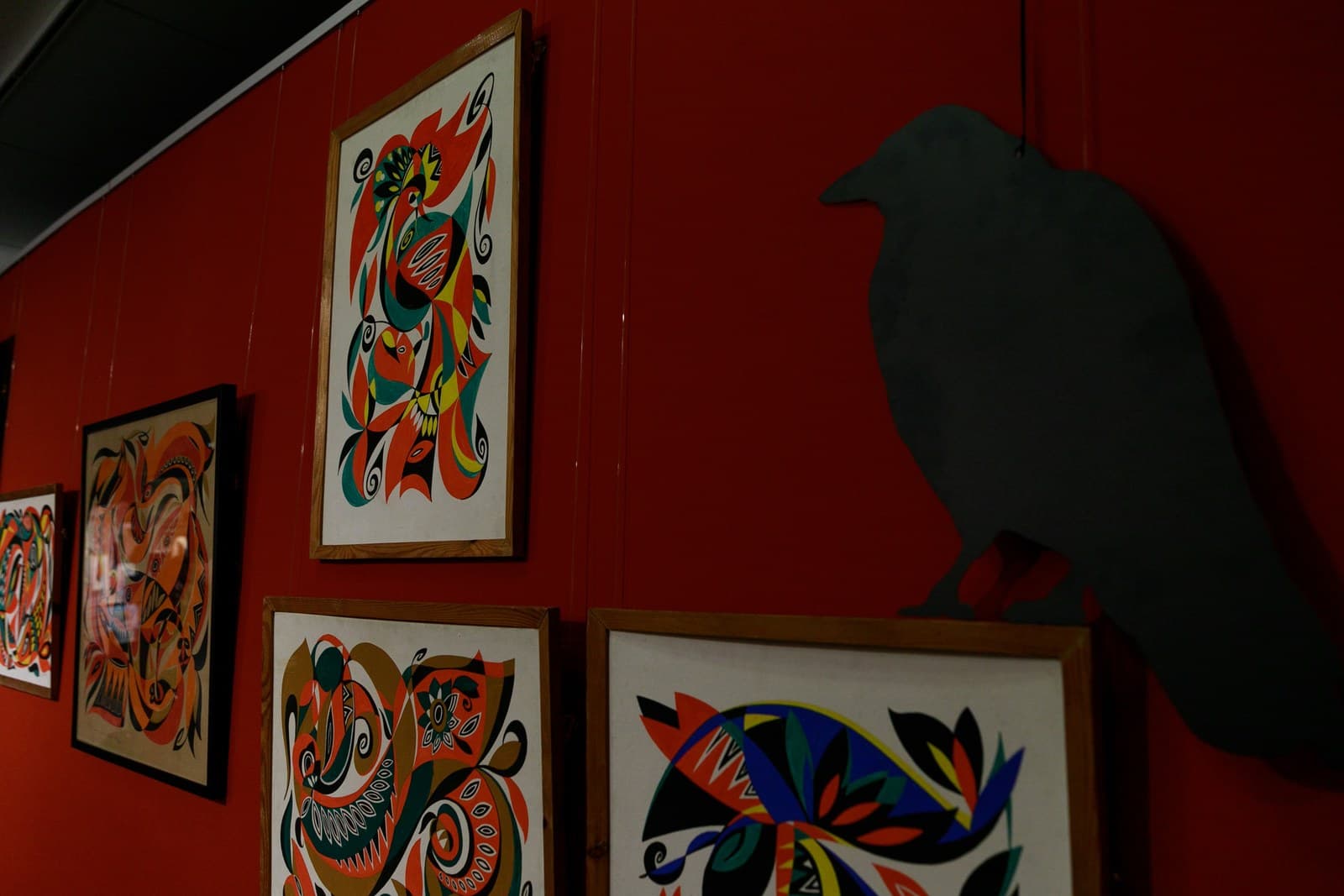
A group of Panchenko's brightly keyed decorative compositions — birds, flowers and interlaced plant forms in flat orange, red, green and black — in which Ukrainian folk ornament is pushed towards near-abstraction. No individual titles or dates are recorded in the sources consulted, so this entry describes the group as exhibited.
Textile appliqués
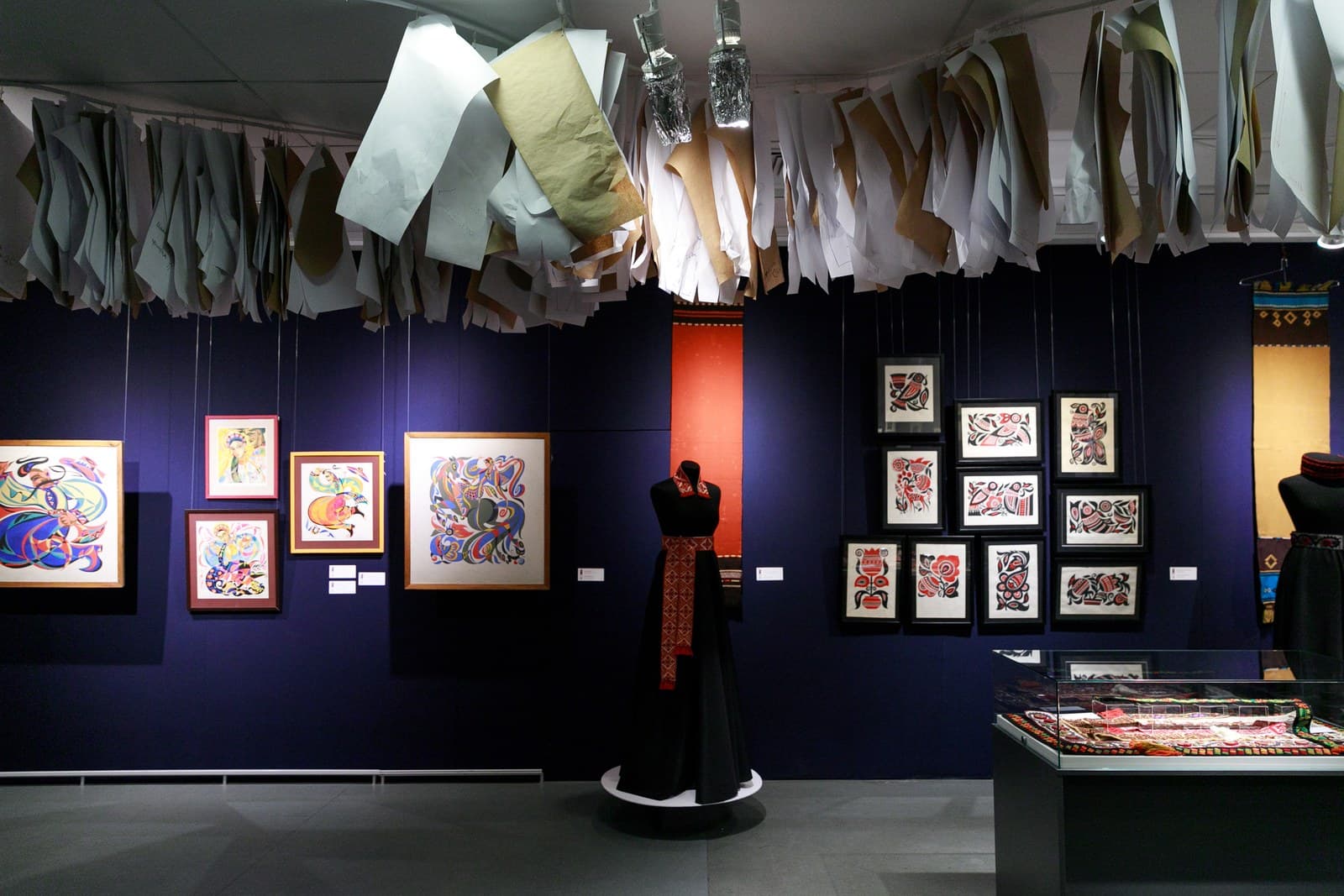
Panchenko's fabric appliqués, the medium most associated with her: cut and layered cloth arranged into stylised birds, flowers and figures in red, black and ochre. The 2008 jubilee exhibition at the National Museum of Ukrainian Literature showed appliqués alongside paintings and graphics; Yevhen Sverstiuk said of that showing that the works "clearly bear the mark of genius".
Clothing designs and costumes
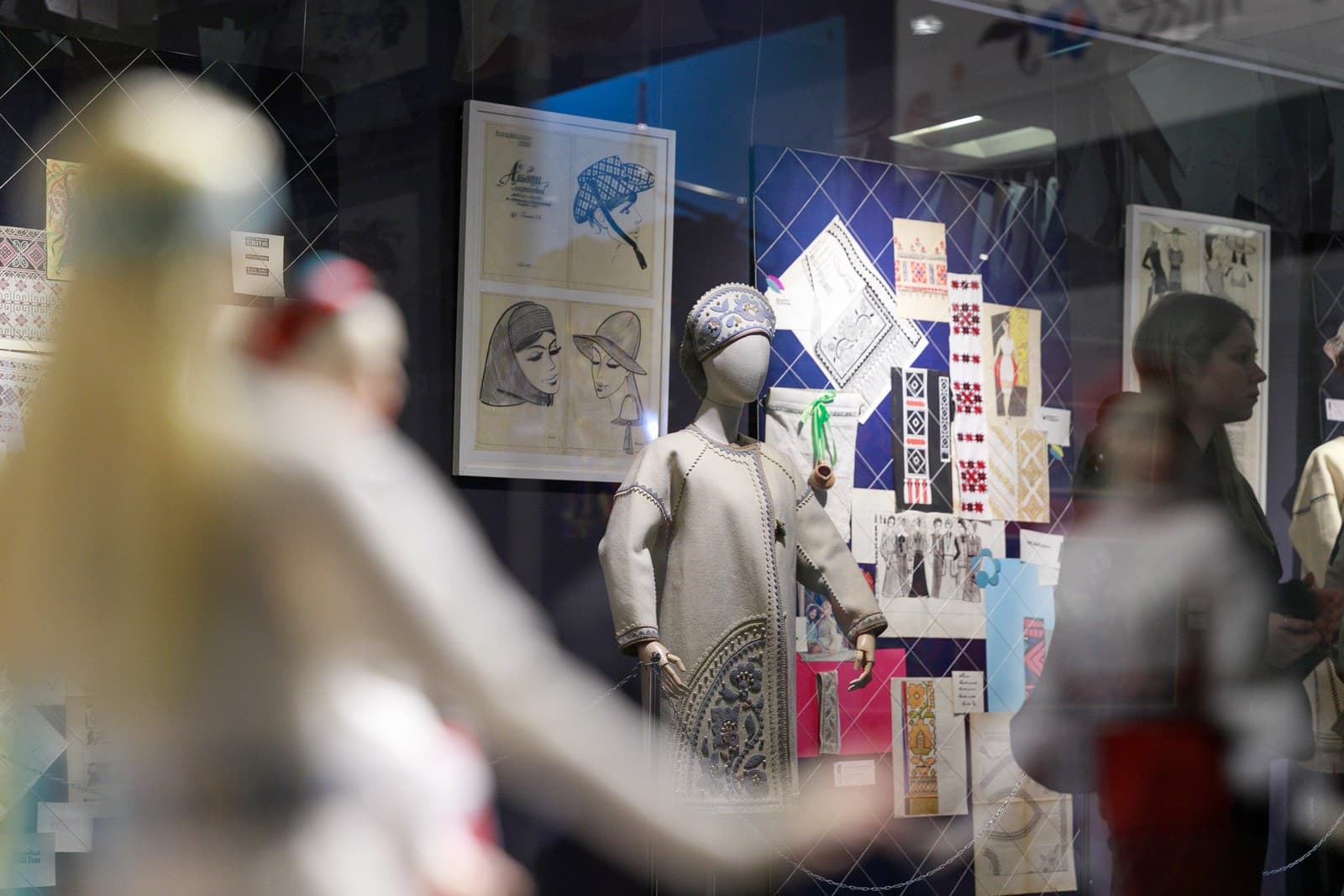
Panchenko's work as an artist-designer at the Project-Design Technology Institute and the Republican House of Models: garment drawings, headwear studies, finished costumes and embroidery samples in which Ukrainian ornament is carried into modern dress. Individual models are not separately titled in the sources consulted.
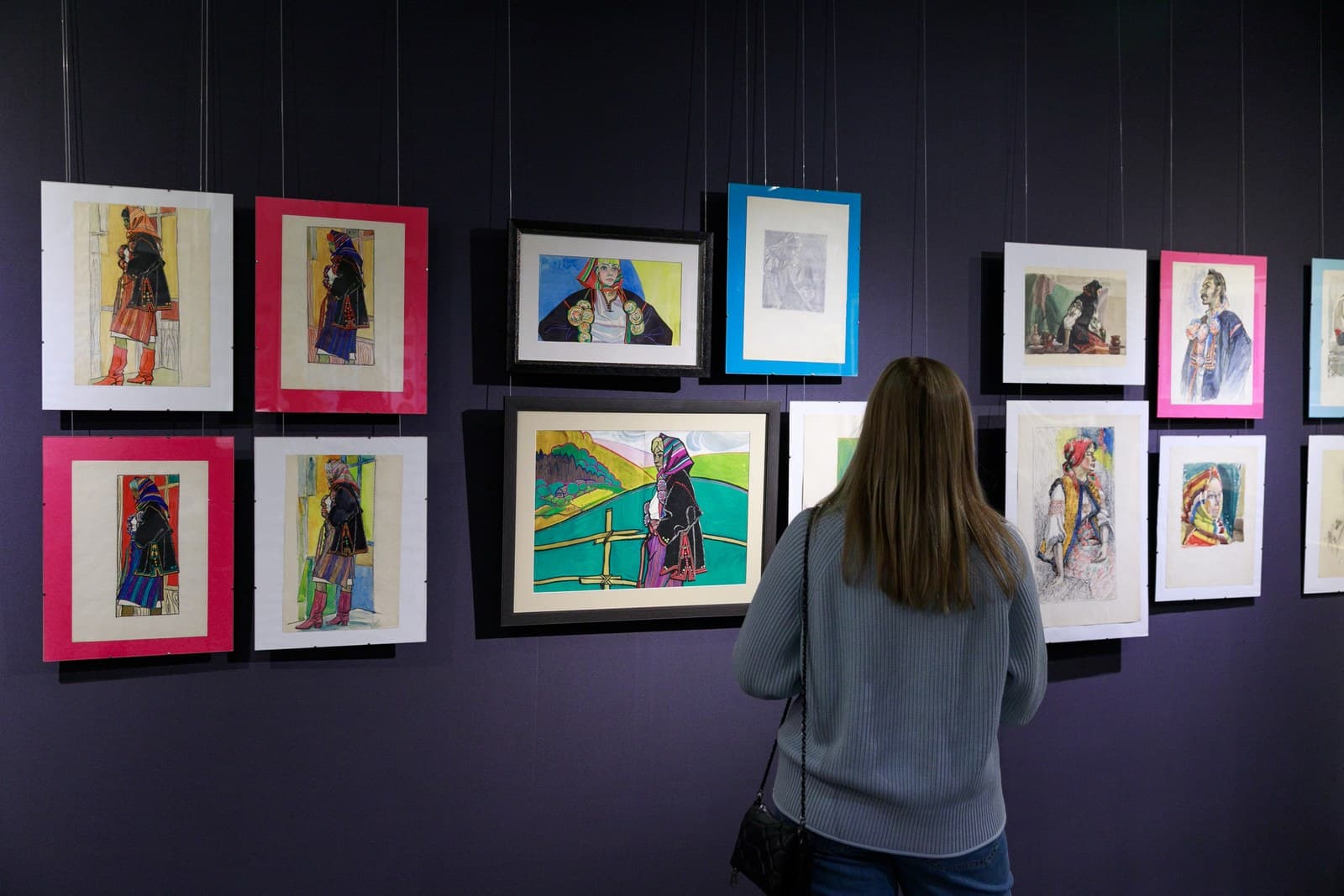
Carpathian Melodies (Carpathian studies)
A series of Carpathian studies in watercolour and gouache, using both traditional and wet, washed-out technique: Hutsul men and women in embroidered coats and headscarves, interiors with pottery, and green mountain fields. Shown by the Museum of the Sixtiers as «Карпатські мелодії»; no individual sheet titles or dates are recorded in the sources consulted.