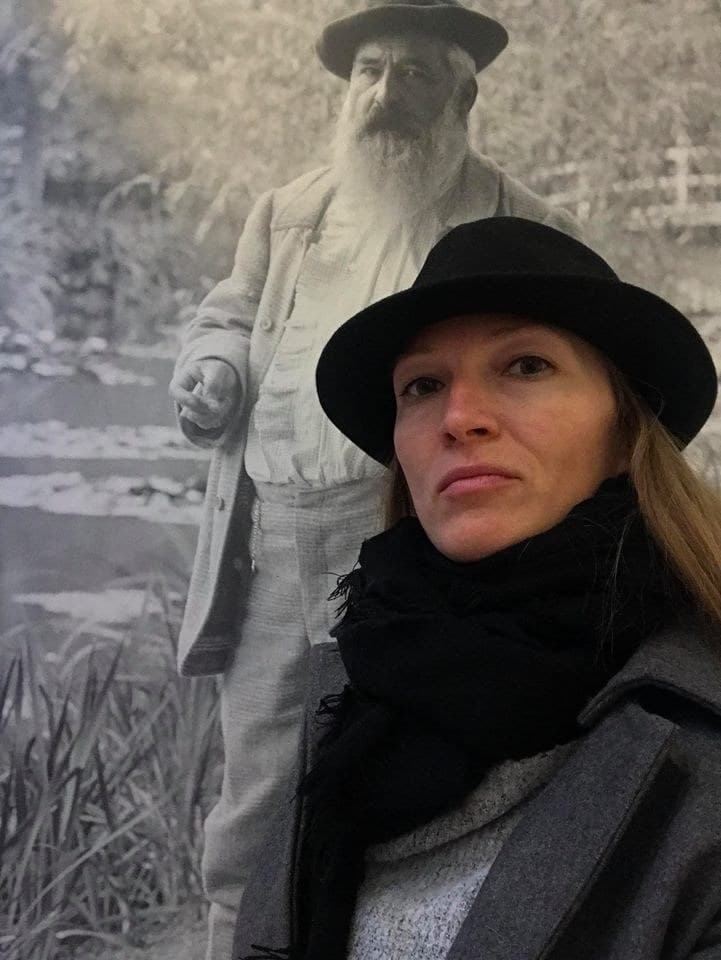
Kateryna Kosianenko
Катерина Косьяненко
b. 1978 · Kyiv, Ukraine
Kateryna Kosianenko is a Kyiv painter and icon-painter whose figurative work fuses Ukrainian Baroque iconography with Renaissance composition and an impressionist feel for landscape light. Honoured Artist of Ukraine (2019) and a member of the National Union of Artists of Ukraine since 2002, she works almost entirely in themed series. She has held more than 35 solo exhibitions and won first prize in painting at the 100th Salon d'Automne in Paris (2003).
Kateryna Volodymyrivna Kosianenko was born on 21 November 1978 in Kyiv. She graduated from the Taras Shevchenko Republican Art School in 1996 and from the National Academy of Fine Arts and Architecture in 2002, studying stage design under the celebrated scenographer Danylo Lider, then completed an assistantship in painting under People's Artist of Ukraine Vasyl Hurin in 2005. Her practice spans easel painting, icon painting, graphics, puppets and design for theatre and cinema, and she builds her work into cycles — "Shadows of Forgotten Ancestors" (2001–02), "Calendar" (2003–05), "Obolon Saints" (2012–13), "Mamais and Mamaivnas", "Graffiti for Anna" (2016), "Earth" (2016), "Tales" (2018–22), "List of Ships" (2019–20), "Victory" (2022–25) and "Eyewitnesses" (2024–25). Stylistically she draws on Ukrainian Baroque icon painting and the folk Cossack Mamai tradition, recasting saints, angels and Mamai figures as inhabitants of contemporary Kyiv districts. Awards include first prize at the 100th Salon d'Automne in Paris (2003), a presidential grant for gifted youth (2004), a silver medal of the National Academy of Arts of Ukraine (2006), fifth prize in painting and the Lorenzo il Magnifico medal at the VII Florence Biennale (2009), a GAUDE POLONIA scholarship (2011) and the Kyiv Art Prize / Serhii Shyshko Award (2018). She held residencies at the Cité Internationale des Arts in Paris (2009) and the Jan Matejko Academy in Kraków (2011), and painted a series at an artists' residency in Frontino, Italy, in 2015. Her work is held by the National Academy of Fine Arts and Architecture, the Museum of the History of Kyiv, the Andrey Sheptytsky National Museum in Lviv and private collections in Ukraine, Poland, France, the Netherlands, the USA, Canada and Croatia. She was named Honoured Artist of Ukraine in 2019.
Art Movements
Folk Decorative Art
Folk decorative art is the visual language of a community, traditionally created by untrained artisans rather than academic artists. It combines utility with ornament, transforming everyday objects like furniture, textiles, and tools into works of cultural expression.
Explore movement →Magical realism
Magical realism is a genre of literature, art, and film that incorporates fantastic, mythical, or surreal elements into otherwise realistic, mundane narratives, treating the magical as normal. It blurs the boundary between reality and fantasy, often used to explore complex social, political, or postcolonial themes through a dreamlike lens. Key Aspects and Characteristics Realistic Setting: Stories are rooted in the real world (e.g., bustling cities, quiet villages), not fantasy realms. Normalised Magic: Strange occurrences are accepted by characters without surprise or terror. Hybridity: Often blends folklore, myths, or spiritual beliefs with modern reality. Sociopolitical Critique: Often used to address issues like colonization, dictatorship, and trauma.
Explore movement →1991–presentContemporary Ukrainian Painting
Painting made in independent Ukraine, from the 1991 declaration of independence onward. It is pluralist rather than programmatic: plein-air landscape and psychological portraiture continue alongside conceptual, minimalist and symbolist strands, with a marked turn after 2014 and especially after 2022 toward wartime subjects, national memory and the vernacular Ukrainian village.
Explore movement →Works by Kateryna Kosianenko
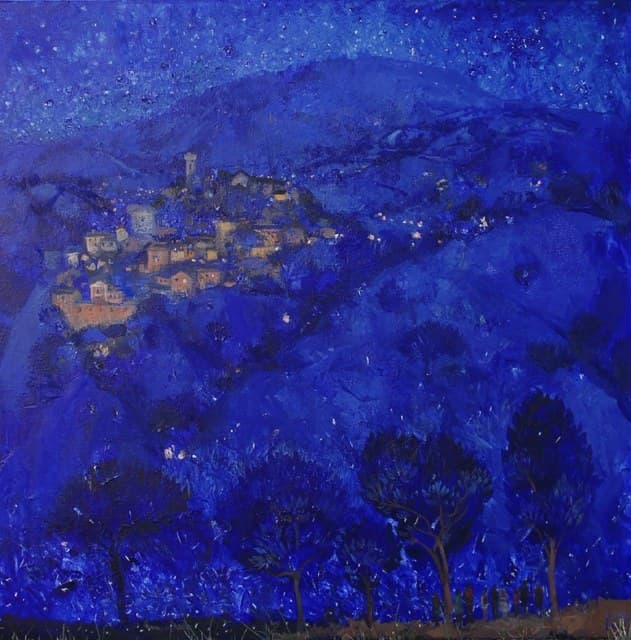
Fireflies (Lucciole)
Painted during the artist's residency in Frontino, Italy, in 2015; the Italian subtitle "lucciole" points to the summer fireflies of the Marche hills. One of the key works of her Frontino cycle.
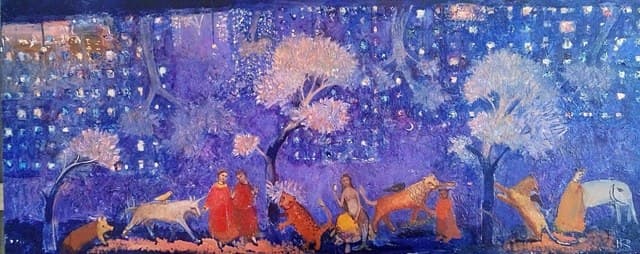
Obolon Bestiary
A wide horizontal frieze from the "Graffiti for Anna" cycle, populating the artist's own Kyiv district of Obolon with a medieval-style bestiary of beasts and hybrid creatures.
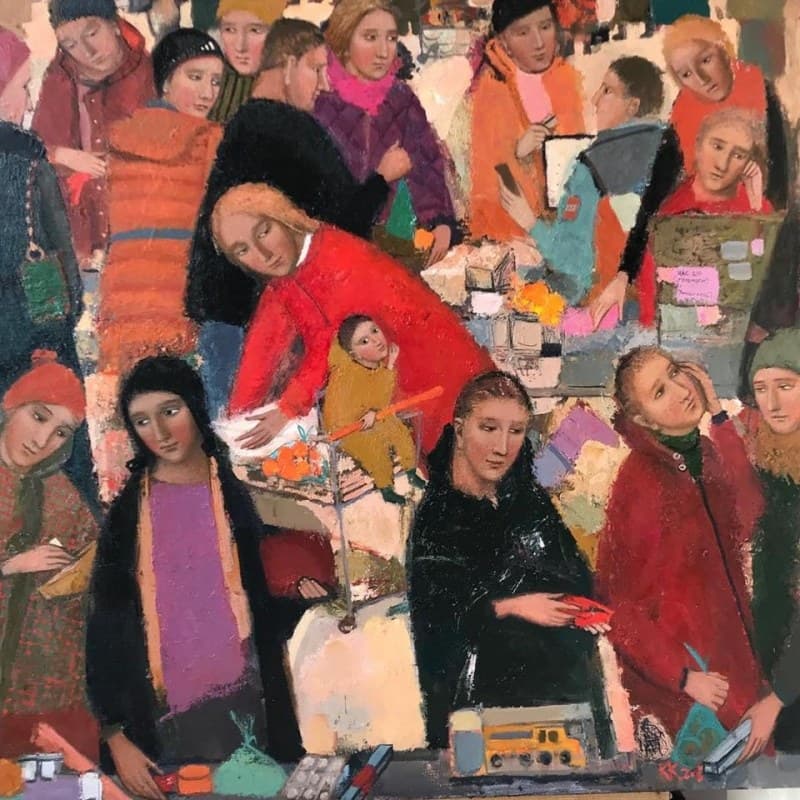
Christmas Sale
A large square composition in which the Nativity is transposed into the crowded commercial bustle of a contemporary Ukrainian city at Christmas.
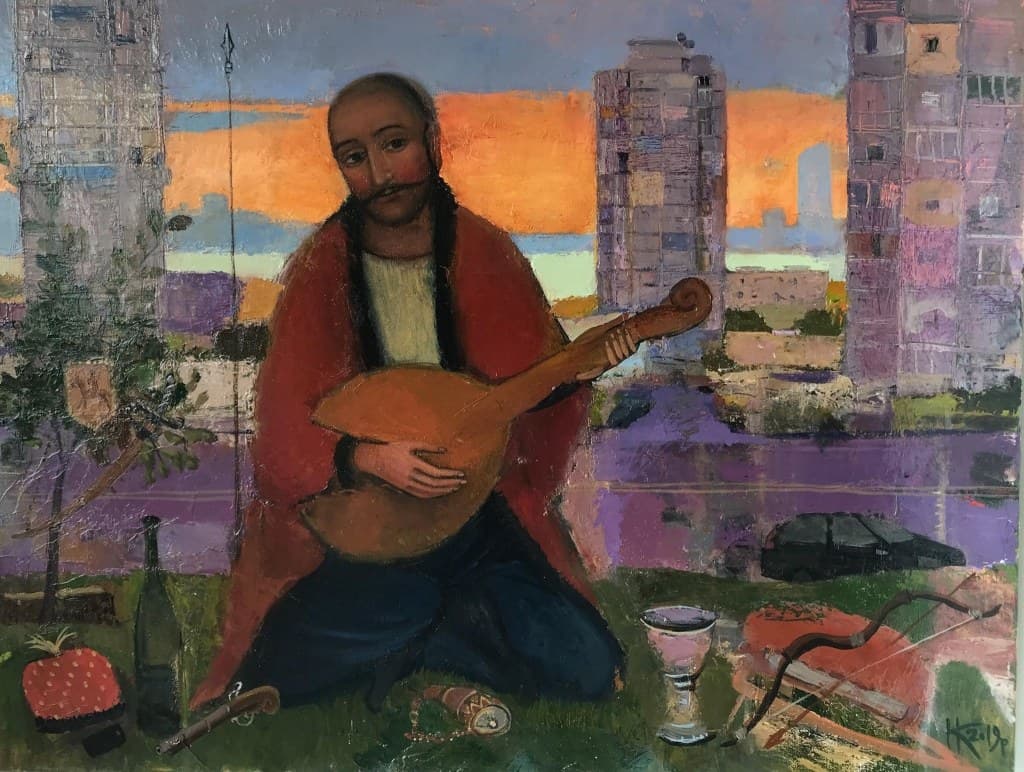
Kyiv Mamai
One of many reworkings of the folk Cossack Mamai icon that run through Kosianenko's output; here the seated Cossack is relocated to a recognisably Kyiv setting.