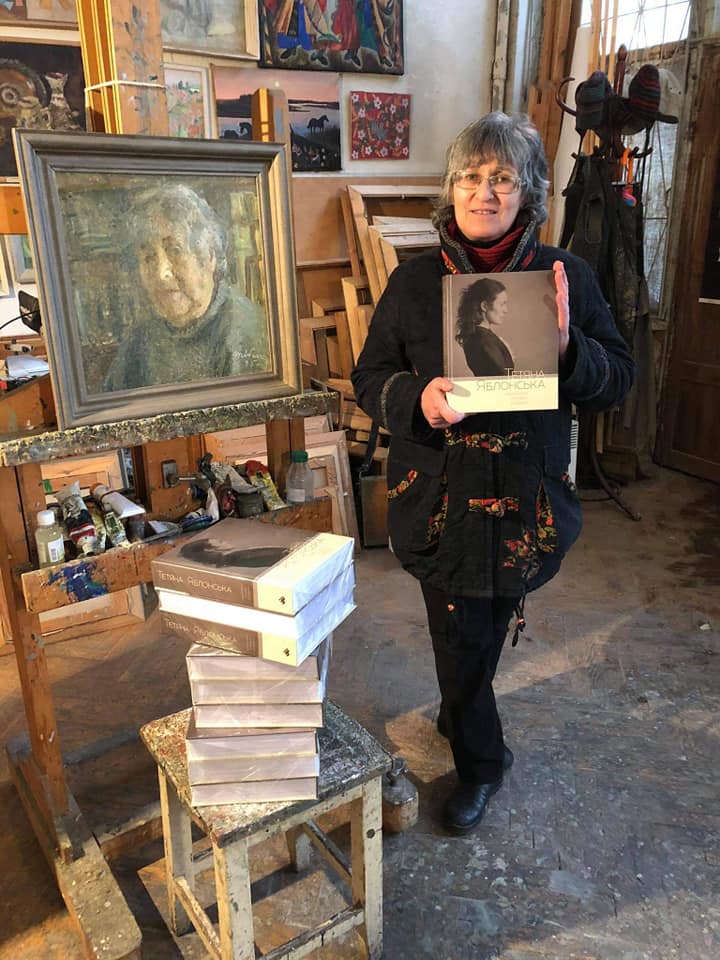
Haiane Ataian is a Kyiv painter born in 1959, the youngest daughter of the Ukrainian painter Tetiana Yablonska and the Armenian-Ukrainian painter Armen Ataian. She works almost entirely in easel landscape, much of it painted on location in and around Kyiv and at the Sedniv artists' residence. Her works are held by the National Museum "Kyiv Art Gallery" and by regional museums in Khmelnytskyi and Zaporizhzhia.
Haiane Armenivna Ataian was born on 23 September 1959 in Kyiv. She is Ukrainian, of partly Armenian descent through her father, the painter Armen Arshakovych Ataian; her mother was Tetiana Yablonska, one of the central figures of twentieth-century Ukrainian painting, and Haiane is the youngest of her three daughters. She graduated from the Kyiv State Art Institute in 1983 from the easel painting studio of Viktor Shatalin, with the diploma painting «Ольвія. Біля джерела» (Olbia. By the Spring). From 1983 to 1990 she worked at the Kyiv Art-Industrial Combine, and has worked independently since 1990; she joined the Union of Artists of Ukraine in 1986. Her subject is overwhelmingly landscape — Kyiv's Podil and hillsides, fog, snow, gardens and flowers — handled in a lyrical, softly decorative manner that stays close to direct observation. She has painted repeatedly at Sedniv in Chernihiv oblast, the long-established residence of the Ukrainian artists' union. Beyond her own painting she has acted as editor and custodian of her mother's legacy, publishing Yablonska's diaries, memoirs and reflections through the Rodovid press in both Ukrainian and Russian editions. Her paintings are held in the National Museum "Kyiv Art Gallery", the Khmelnytskyi and Zaporizhzhia regional art museums, a museum in Taiwan, and numerous private collections.
Art Movements
Realism
Realism is an artistic movement that sought to depict reality as accurately and objectively as possible, holding that the purpose of art is to reflect all aspects of existence, rather than merely its idealized representation. The term was introduced by the French literary critic Jules Champfleury in the 1850s to denote art that opposed Romanticism and Academicism. In the visual arts, the significance of Realism as a style is quite controversial, and its boundaries are undefined. In a narrower sense, realism is understood as positivism, a movement in the visual arts of the second half of the 19th century. One of the first realists was the French artist Gustave Courbet (1819–1877), who opened his solo exhibition “The Pavilion of Realism” in Paris in 1855. Before him, artists of the Barbizon School—Théodore Rousseau, Jean-François Millet, and Jules Breton—worked in a realistic style. In the 1870s, realism split into two main movements: naturalism and impressionism. In contemporary painting, realism borders on the grotesque and anti-glamour.
Explore movement →1991–presentContemporary Ukrainian Painting
Painting made in independent Ukraine, from the 1991 declaration of independence onward. It is pluralist rather than programmatic: plein-air landscape and psychological portraiture continue alongside conceptual, minimalist and symbolist strands, with a marked turn after 2014 and especially after 2022 toward wartime subjects, national memory and the vernacular Ukrainian village.
Explore movement →Works by Haiane Ataian
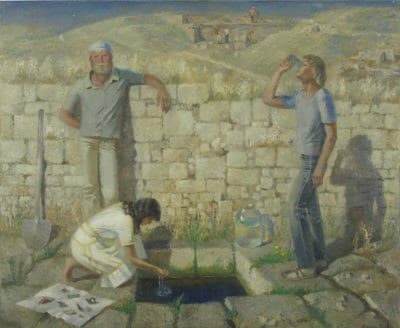
By the Spring. Olbia
Ataian's diploma painting from the Kyiv State Art Institute, set at the ancient Greek site of Olbia on the Black Sea coast. The museum also holds some twenty preparatory studies and drawings for it, making it one of her most thoroughly documented works.
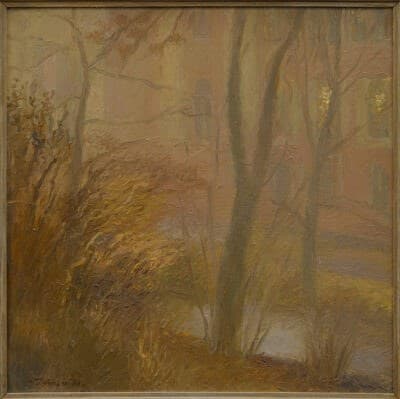
Fog
A square canvas in which landscape is almost dissolved into mist, typical of the atmospheric painting Ataian pursued through the 1990s. Fog and rising damp recur across her work as a way of flattening depth into tone.