Fedir Konovaliuk
Федір Коновалюк
1890–1984 · Kalivka, Podillia Governorate, Russian Empire (now Yahidne, Vinnytsia Oblast, Ukraine)
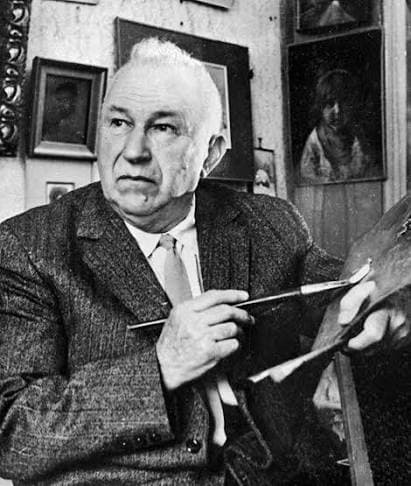
Fedir Konovaliuk was a Kyiv painter and illustrator who began as an icon painter in the Pechersk Lavra workshop and became one of the most exact landscapists of the Ukrainian village. He worked for decades alongside Ivan Yizhakevych, together producing illustrations for the classics of Ukrainian literature. His small, densely coloured panels record identifiable places, seasons and even particular days rather than picturesque scenery.
Fedir Konovaliuk was born in the village of Kalivka in Podillia, now Yahidne in Vinnytsia Oblast. He trained first in the icon-painting workshop of the Kyiv Pechersk Lavra from 1903 to 1909, then at the Kyiv Art School from 1911 to 1915 under Volodymyr Menk and Oleksandr Murashko, briefly at the Imperial Academy of Arts in Petrograd from 1915 to 1917, and finally at the Kyiv Art Institute from 1925 to 1927 in Fedir Krychevskyi's studio. In the 1900s and 1910s he painted church interiors in Kyiv and Katerynoslav (now Dnipro), and he went on to work for many years in partnership with Ivan Yizhakevych, the two of them producing large bodies of illustration for Ukrainian literature, including Kotliarevskyi's 'Eneida' and the poems of Shevchenko. He continued the tradition of the Ukrainian painters of the turn of the century rather than following Soviet developments, and his work is characterised by miniature scale and a very fine sense of colour. What sets his landscapes apart is their specificity: they are views of a named, recognisable place at a particular season and often a particular day, and he sought no especially picturesque subjects, holding that beauty was already present in any corner of nature. He was drawn all his life to the old Ukrainian village — thatched cottages, clay-daubed walls, wattle fences — and his pictures were, as the art historian Ihor Sharov puts it, too openly national to fit the ideological requirements of Socialist Realism, which kept him at the margins of official recognition. He told his wife that his paintings were his children, who should outlive their parents and carry their name. He lived and worked in Kyiv and died there in 1984; a retrospective was mounted by the Union of Artists of the Ukrainian SSR in 1966 and a centenary exhibition catalogue was published in 1990.
Art Movements
Realism
Realism is an artistic movement that sought to depict reality as accurately and objectively as possible, holding that the purpose of art is to reflect all aspects of existence, rather than merely its idealized representation. The term was introduced by the French literary critic Jules Champfleury in the 1850s to denote art that opposed Romanticism and Academicism. In the visual arts, the significance of Realism as a style is quite controversial, and its boundaries are undefined. In a narrower sense, realism is understood as positivism, a movement in the visual arts of the second half of the 19th century. One of the first realists was the French artist Gustave Courbet (1819–1877), who opened his solo exhibition “The Pavilion of Realism” in Paris in 1855. Before him, artists of the Barbizon School—Théodore Rousseau, Jean-François Millet, and Jules Breton—worked in a realistic style. In the 1870s, realism split into two main movements: naturalism and impressionism. In contemporary painting, realism borders on the grotesque and anti-glamour.
Explore movement →Impressionism
Impressionism was a 19th-century French art movement (1870s-1880s) that revolutionized Western art by capturing fleeting moments and the shifting effects of light using visible brushstrokes, open composition, and vibrant colors. Focusing on modern life and landscapes, key artists included Claude Monet, Pierre-Auguste Renoir, Camille Pissarro, and Berthe Morisot. Usage Examples & Characteristics: Plein Air Painting: Painting outdoors to capture natural light, such as Monet’s studies of Rouen Cathedral or haystacks in varying weather conditions. Visible Brushwork: Thick, rapid, or broken brushstrokes intended to convey a sense of motion and the ephemeral nature of a scene. Everyday Subjects: Depicting leisure activities, urban life in Paris, or landscapes rather than historical or mythological scenes. Unusual Visual Angles: Inspired by photography, artists like Degas used candid-style, unconventional framing of subjects, such as dancers or laundresses. "Impressionist Music": A similar approach in music and dance, focusing on mood and atmosphere over rigid structure, with artists like Claude Debussy and Maurice Ravel.
Explore movement →Works by Fedir Konovaliuk
Winter
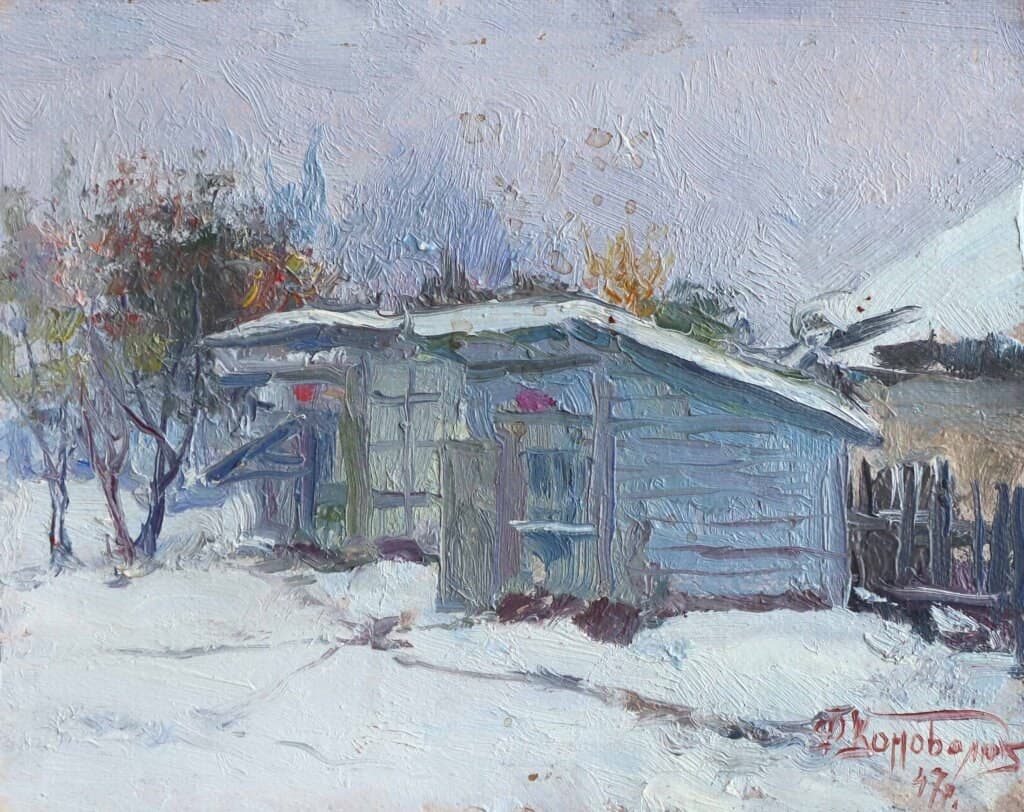
A postcard-sized winter panel, an extreme example of the miniature scale on which Konovaliuk often worked, made in the same immediate post-war years as his blossoming orchards.
Blossoming Ukrainian Garden
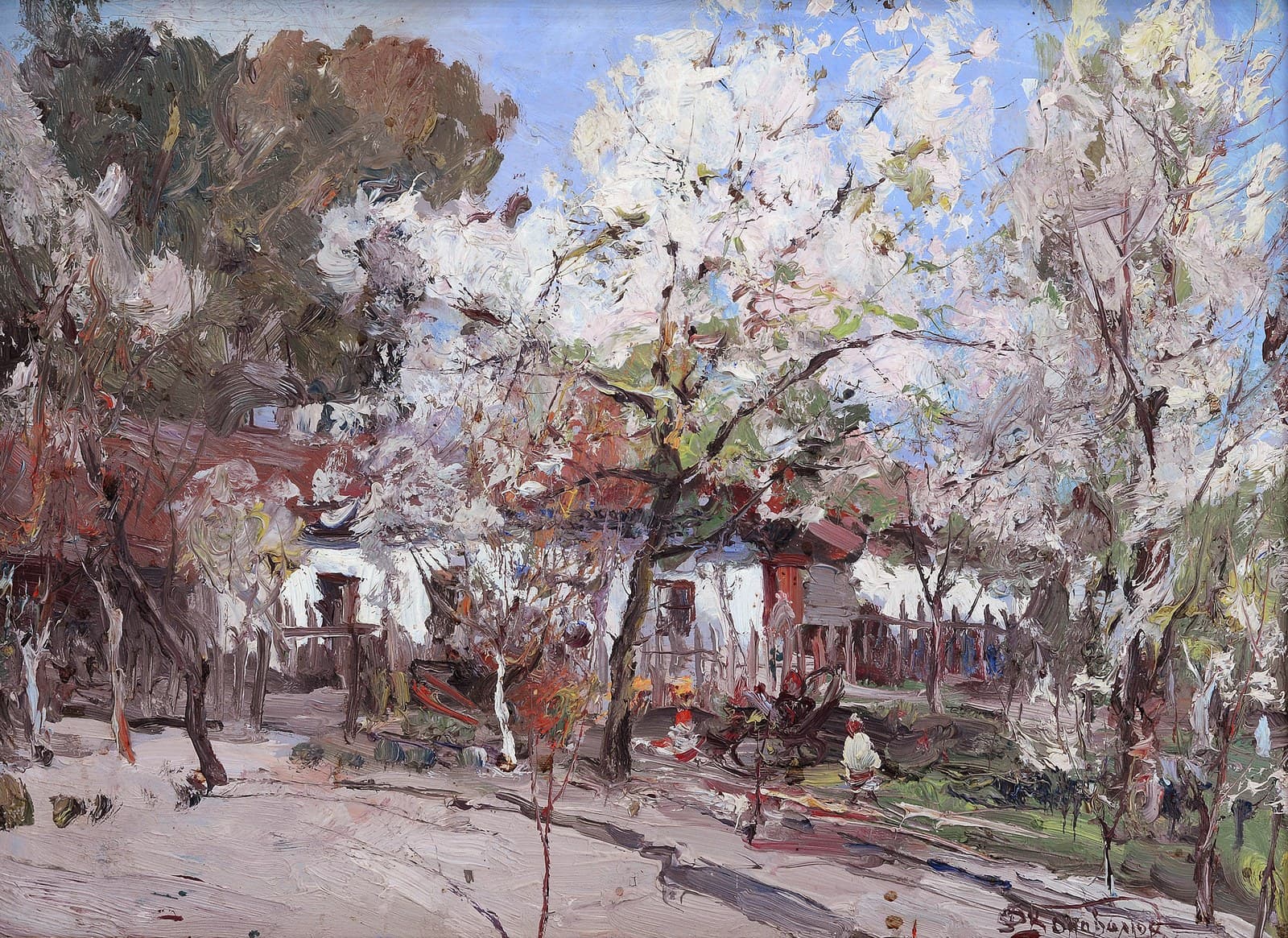
A small post-war panel of an orchard in full blossom, the kind of specific, dated Ukrainian village view Konovaliuk built his reputation on. Signed lower right and catalogued by Goldens as lot 4 of its Ukrainian collectible art exhibition.
Kodra Village
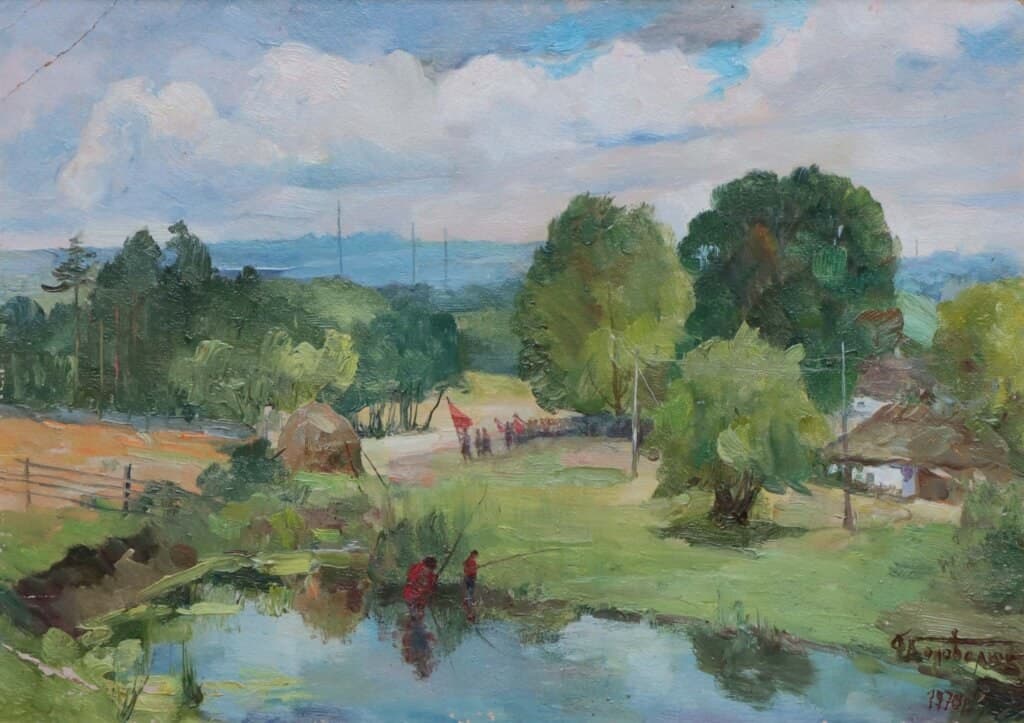
A named-place village view of Kodra, in the Kyiv region, typical of Konovaliuk's insistence that a landscape record a specific settlement rather than a generic rural scene.
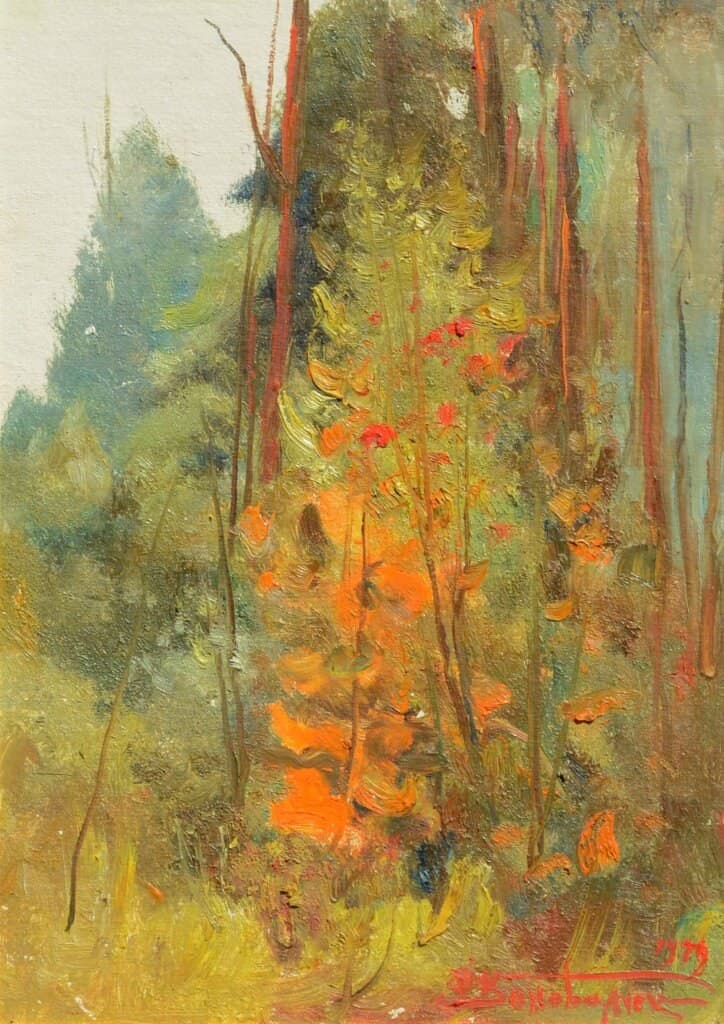
Autumn Landscape
A late upright autumn panel from Konovaliuk's ninth decade, still working the same small format and the same close attention to the colour of a particular season.